Days in the Sun

From solstice to solstice, this six month long exposure compresses time from the 21st of June till the 21st of December, 2011, into a single point of view.

Wolf Moon

A full moon looking yellowish-orange, which the ancients and old people dubbed as wolf moon, accompanied by many mythical stories.

A Star Factory

These are the places in the Milky Way galaxy where stars are formed. Awesome, isn't it?

The Ghost Nebula

The Ghost Nebula, after being captured by the Hubble space telescope

Saturn's Iapetus Moon

This is Saturn's Iapetus moon, which looks painted and colorful, setting it apart from the other moons.

Saturday, August 13, 2011

Light

Light is a form of energy is electromagnetic radiation that is visible to the human eye, and is responsible for the sense of sight. Light itself is invisible but other things visible. The range of visible light in terms of wavelength is from 400nm to 800nm and in terms of frequency is from 400 THz to 800 THz. Light is emitted as tiny packets of quanta. This quanta is called photon. Light behaves as a wave as well as a particle and this property is known as wave-particle duality. Light obeys laws of reflection, refraction, defraction and interference.


The Electromagnetic Spectrum
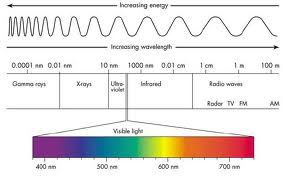
Generally, EM radiation (the designation 'radiation' excludes static electric and magnetic and near fields) is classified by wavelength into radio, microwave, infrared, the visible region we perceive as light,ultraviolet, X-rays and gamma rays.
The behaviour of EM radiation depends on its wavelength. Higher frequencies have shorter wavelengths, and lower frequencies have longer wavelengths. When EM radiation interacts with single atoms and molecules, its behaviour depends on the amount of energy per quantum it carries.
Refraction
Refraction
When a ray of light passes from a denser medium to a rarer medium, it undergoes refraction. Refraction is the bending of a wave with respect to the medium's optical density( not its density ). 
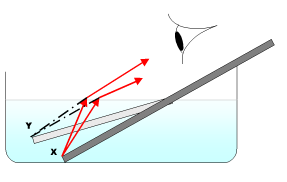
Laws of Refraction: 
  1. The incident ray, the refracted ray, and the normal all lie in the same plane.
  2. The Snell's law : the ratio of the sines of the angles of incidence and refraction is equivalent to the ratio of phase velocities in the two media, or equivalent to the opposite ratio of the indices of refraction                                           
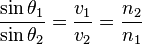
                                           \frac{\sin\theta_1}{\sin\theta_2} = \frac{v_1}{v_2} = \frac{n_2}{n_1}                
                                
Refraction takes place because the speed of light is different in different mediums. In vacuum or air, the speed of light is 299,792,458 m/s or simply 3*10^8 m/s. But as it enters a different medium, the speed of light decreases because of absorbtion and remission of photons. The speed of light in water is 2.25*10^8.


        Refractive index: Refractive index is the ratio of speed of light in vacuum to the speed of light in the respective medium. It is denoted by Î¼. Î¼ =   Speed of light in vacuum 
                                                                 Speed of light in the medium.


A list of Refractive index are given below:


            Material    Î¼(Refractive Index)
Vacuum1
Air at STP1.000277
Helium1.000036
Hydrogen1.000132
Carbon dioxide1.00045
Benzene1.501
Water1.3330
Acetone1.36
Diamond2.419


Monday, August 8, 2011

Pulsars

 Pulsars are highly magnetized, rotating neutron stars that emit a beam of electromagnetic radiation. The radiation can only be observed when the beam of emission is pointing towards the Earth. This is called the lighthouse effect and gives rise to the pulsed nature that gives pulsars their name. Because neutron stars are very dense objects, the rotation period and thus the interval between observed pulses is very regular. For some pulsars, the regularity of pulsation is as precise as an atomic clock. The observed periods of their pulses range from 1.4 milliseconds to 8.5 seconds. A few pulsars are known to have planets orbiting them


Formation
The events leading to the formation of a pulsar begin when the core of a massive star is compressed during a supernova, which collapses into a neutron star. The neutron star retains most of its angular momentum, and since it has only a tiny fraction of its progenitor's radius (and therefore its moment of inertia is sharply reduced), it is formed with very high rotation speed. A beam of radiation is emitted along the magnetic axis of the pulsar, which spins along with the rotation of the neutron star. The magnetic axis of the pulsar determines the direction of the electromagnetic beam, with the magnetic axis not necessarily being the same as its rotational axis. This misalignment causes the beam to be seen once for every half rotation of the neutron star, which leads to the "pulsed" nature of its appearance. The beam originates from the rotational energy of the neutron star, which generates an electrical field from the movement of the very strong magnetic field, resulting in the acceleration of protons and electrons on the star surface and the creation of an electromagnetic beam emanating from the poles of the magnetic field. This rotation slows down over time as electromagnetic power is emitted. When a pulsar's spin period slows down sufficiently, the radio pulsar mechanism is believed to turn off (the so-called "death line"). This turn-off seems to take place after about 10–100 million years, which means of all the neutron stars in the 13.6 billion year age of the universe, around 99% no longer pulsate. To date, the slowest observed pulsar has a period of 8 seconds.


Monday, August 1, 2011

Black Hole


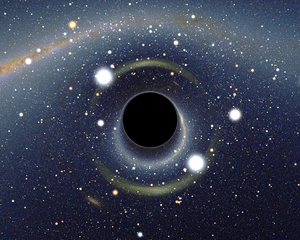
A black hole is a region of space from which nothing, not even light, can escape.  It is called "black" because it absorbs all the light that hits the horizon, reflecting nothing, just like a perfect black body in thermodynamics.Black holes of stellar mass are expected to form when heavy stars collapse in a supernova at the end of their life cycle. After a black hole has formed it can continue to grow by absorbing mass from its surroundings. By absorbing other stars and merging with other black holes, super massive black holes of millions of solar masses may be formed. Quantum mechanics predicts that black holes emit radiation like a black body with a finite temperature. This temperature is inversely proportional to the mass of the black hole, making it difficult to observe this radiation for black holes of stellar mass or greater.


Despite its invisible interior, the presence of a black hole can be inferred through its interaction with other matter. Astronomers have identified numerous stellar black hole candidates in binary systems, by studying their interaction with their companion stars. There is growing consensus that supermassive black holes exist in the centers of most galaxies. In particular, there is strong evidence of a black hole of more than 4 million solar masses at the center of our Milky Way.
The theory of general relativity predicts that a sufficiently compact mass will deform space time to form a black hole. Around a black hole there is a mathematically defined surface called an event horizon that marks the point of no return.
Time travel: Scientists predict that if anything is able to just escape form the event horizon, then that thing will not be sucked into a black hole. Time travelling that has been thought of from long times, is said to be possible for a person who has escaped the event horizon. A body of huge amount of mass in it is said to slow time because of its own gravitation. So for a person in the gravitational field of the black hole, the time will run slower. So he might as well make time travel possible because he'd reach the past. This has only been though of and not proved in reality.


A body of huge mass

Monday, July 25, 2011

Pluto

(symbol of Pluto)

Pluto

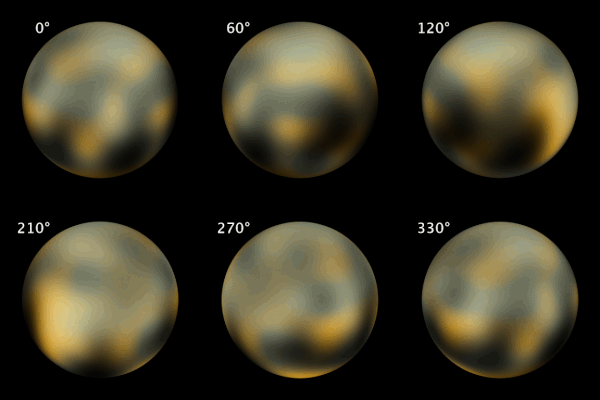
Pluto, was the 9th planet of the Solar System but on August 24, 2006, the International Astronomical Union (IAU) defined what it means to be a 'planet' within the Solar System. Thus it was excluded as a planet. It was recategorized due to recent discoveries as a dwarf planet along with Eris and Ceres and is now considered the 2nd largest dwarf planet within the newly charted Kuiper belt. It is the tenth most massive body observed directly orbiting the Sun. 

The definition of planet set in 2006 by the (IAU) states that, in the Solar System, a planet is a celestial body which:
  1. is in orbit around the Sun,
  2. has sufficient mass to assume hydrostatic equilibrium (a nearly round shape), and
  3. has cleared the neighbourhood around its orbit.
Pluto has four known moons, the largest being Charon, along with Nix and Hydra, discovered in 2005. Like other members of the Kuiper belt, Pluto is composed primarily of rock and ice and is relatively small: approximately a fifth the mass of the Earth's Moon and a third its volume. It has an eccentric and highly inclined orbit that takes it from 30 to 49 AU (4.4–7.4 billion km) from the Sun. This causes Pluto to periodically come closer to the Sun than Neptune. As of 2011, it is 32.1 AU from the Sun. Pluto and Charon are sometimes described as a binary system because the barycenter of their orbits does not lie within either body.


From its discovery in 1930 until 2006, Pluto was classified as a planet. In the late 1970s, following the discovery of minor planet 2060 Chiron in the outer Solar System and the recognition of Pluto's relatively low mass, its status as a major planet began to be questioned. In the late 20th and early 21st century, many objects similar to Pluto were discovered in the outer Solar System, notably the scattered disc object Eris in 2005, which is 27% more massive than Pluto. After the reclassification, Pluto was added to the list of minor planets and given the number 134340. A number of scientists continue to hold that Pluto should be classified as a planet.

Sunday, July 24, 2011

Neptune


Neptune is the eighth and farthest planet from the Sun in the Solar System. Named for the Roman god of the sea, it is the fourth-largest planet by diameter and the third-largest by mass. Neptune is 17 times the mass of Earth and is slightly more massive than its near-twin Uranus, which is 15 times the mass of Earth but not as dense.[12] On average, Neptune orbits the Sun at a distance of 30.1 AU, approximately 30 times the Earth–Sun distance. Its astronomical symbol is ♆, a stylized version of the god Neptune's trident.
Discovered on September 23, 1846, Neptune was the first planet found by mathematical prediction rather than by empirical observation. Unexpected changes in the orbit of Uranus led Alexis Bouvard to deduce that its orbit was subject to gravitational perturbation by an unknown planet. Neptune was subsequently observed by Johann Galle within a degree of the position predicted by Urbain Le Verrier, and its largest moon, Triton, was discovered shortly thereafter, though none of the planet's remaining 12 moons were located telescopically until the 20th century. Neptune has been visited by only one spacecraft, Voyager 2, which flew by the planet on August 25, 1989.
Neptune is similar in composition to Uranus, and both have compositions which differ from those of the larger gas giants Jupiter and Saturn. Neptune's atmosphere, while similar to Jupiter's and Saturn's in that it is composed primarily of hydrogen and helium, along with traces of hydrocarbons and possibly nitrogen, contains a higher proportion of "ices" such as water, ammonia and methane. Astronomers sometimes categorize Uranus and Neptune as "ice giants" in order to emphasize these distinctions. The interior of Neptune, like that of Uranus, is primarily composed of ices and rock. Traces of methane in the outermost regions in part account for the planet's blue appearance.
The Great Dark Spot

In contrast to the relatively featureless atmosphere of Uranus, Neptune's atmosphere is notable for its active and visible weather patterns. For example, at the time of the 1989 Voyager 2 flyby, the planet's southern hemisphere possessed a Great Dark Spot comparable to the Great Red Spot on Jupiter. These weather patterns are driven by the strongest sustained winds of any planet in the Solar System, with recorded wind speeds as high as 2,100 km/h. Because of its great distance from the Sun, Neptune's outer atmosphere is one of the coldest places in the Solar System, with temperatures at its cloud tops approaching −218 °C (55 K). Temperatures at the planet's centre are approximately 5,400 K (5,000 °C). Neptune has a faint and fragmented ring system, which may have been detected during the 1960s but was only indisputably confirmed in 1989 by Voyager 2.

Wednesday, July 13, 2011

Uranus


Uranus

Uranus is the seventh planet from the Sun. It has the third-largest planetary radius and fourth-largest planetary mass in the Solar System. Sir William Herschel announced its discovery on March 13, 1781, expanding the known boundaries of the Solar System for the first time in modern history. Uranus was also the first planet discovered with a telescope.

Uranus is named after the ancient Greek deity of the sky Uranus, the father of Cronus. Though it is visible to the naked eye like the five classical planets, it was never recognized as a planet by ancient observers because of its dimness and slow orbit. Like the other giant planets, Uranus has a ring system, a magnetosphere, and numerous moons. The Uranian system has a unique configuration among the planets because its axis of rotation is tilted sideways, nearly into the plane of its revolution about the Sun. As such, its north and south poles lie where most other planets have their equators. Seen from Earth, Uranus's rings can sometimes appear to circle the planet like an archery target and its moons revolve around it like the hands of a clock, though in 2007 and 2008 the rings appeared edge-on. Terrestrial observers have seen signs of seasonal change and increased weather activity in recent years as Uranus approached its equinox. 
Uranus is similar in composition to Neptune, and both are of different chemical composition than the larger gas giants Jupiter and Saturn.The wind speeds on Uranus can reach 250 meters per second (900 km/h, 560 mph). It is the coldest planetary atmosphere in the Solar System, with a minimum temperature of 49 K (–224 °C). Uranus's atmosphere, while similar to Jupiter and Saturn's in its primary composition of hydrogen and helium, contains more "ices" such as water, ammonia and methane, along with traces of hydrocarbons. So, astronomers have placed them in a separate category, the 'ice giants'. The interior of Uranus is mainly composed of ices and rock. In 1986, images from Voyager 2 showed Uranus as a virtually featureless planet in visible light without the cloud bands or storms associated with the other giants.