Days in the Sun

From solstice to solstice, this six month long exposure compresses time from the 21st of June till the 21st of December, 2011, into a single point of view.

Wolf Moon

A full moon looking yellowish-orange, which the ancients and old people dubbed as wolf moon, accompanied by many mythical stories.

A Star Factory

These are the places in the Milky Way galaxy where stars are formed. Awesome, isn't it?

The Ghost Nebula

The Ghost Nebula, after being captured by the Hubble space telescope

Saturn's Iapetus Moon

This is Saturn's Iapetus moon, which looks painted and colorful, setting it apart from the other moons.

Wednesday, October 26, 2011

Definitions of Units of Physical quantities

There are 7 fundamental physical quantities that we use in our daily life. They are

  1. length(m)
  2. mass(kg)
  3. time(s)
  4. electric current(A)
  5. temperature(K)
  6. amount of substance(n)
  7. luminous intensity(L)
A system called as the System International(SI) decided to define these fundamental quantities.
The definitions are as follows
  1. Meter: The meter is the distance travelled by light in 1/29979248 seconds.
  2. Kilogram: The Kilogram is the mass of a cylinder made of platinum iridium alloy kept at the International Bureau of Weights and Measures at Sevres, near Paris
  3. Second: The second is the time taken by light of specified wavelength emitted by a cesium-133 atom to execute 9,192,631,770 vibrations.
  4. Ampere: The Ampere is that current which when flowing in each of two infinitely long straight parallel conductors of negligible cross-section placed one meter apart in vacuum produces between the conductors, a force of 2 x 10^-7 newton per meter length of each conductor.
  5. Kelvin: The kelvin is 1/273.16 of the thermodynamic temperature of triple point of water.
  6. Mole: The mole is the amount of substance that contains as many elementary entities(atoms or molecules) as there are number of atoms in 0.012kg of carbon-12. This number is called Avogadro constant and its value is 6.02214199 x 10^23.
  7. Candela: The candela is the luminous intensity of a black body of surface area 1/600 m² placed at the temperature of freezing platinum and at a pressure of 101,325 newton per square meter, in the direction perpendicular to its surface.
  8. Radian: The radian is the angle subtended at the center of a circle by an arc whose length is equal to the radius of the circle.
  9. Steradian: The steradian is the solid angle subtended at the center of a sphere by an area of its surface equal to the square of the radius of the sphere.

Fundamental quantity
Symbol of the quantity
Name of the SI Unit
Symbol of the unit
1
Length
                 l
meter
            m
2
Mass
                m
kilogram
            kg
3
Time
                 t
second
            s
4
Electric Current
                 I
ampere
            A
5
Temperature
                 T
kelvin
            K
6
Amount of substance
                 n
mole
            mol
7
Luminous Intensity
                 L
candela
            cd

Monday, October 24, 2011

A New Planet


New Planet Kepler-16b discovered by NASA in 2011. Scientists across the world are perplexed. The discovery of a star that orbits around two suns has stunned many. Others are amazed. But it may take years to verify the reports coming from a NASA satellite Kepler, launched two years ago that a star some two hundred light years away orbits around two suns.
Being called Kepler or Tatooine planet, it is made up of hard rocks where gasses are frozen all over it. Reports suggest that it is the size of Saturn.
While detailing about the Kepler Mission of NASA, its website says, “Considering that we want to find planets in the habitable zone of stars like the Sun, the time between transits is about one year. To reliably detect a sequence one needs four transits. Hence, the mission duration needs to be at least three and one half years. If the Kepler Mission continues for longer, it will be able to detect smaller, and more distant planets as well as a larger number of true Earth analogs”.
It further says, “The Kepler instrument is a specially designed 0.95-meter diameter telescope called a photometer or light meter. It has a very large field of view for an astronomical telescope 105 square degrees, which is comparable to the area of your hand held at arm’s length. The fields of view of most telescopes are less than one square degree. Kepler needs the large field of view in order to observe the large number of stars. It stares at the same star field for the entire mission and continuously and simultaneously monitors the brightnesses of more than 100,000 stars for at least 3.5 years, the initial length of the mission, which can be extended”.
But the new star is reported to be lifeless and made of hard rocks all over it. The two suns it is orbiting are smaller in size compared to our own sun. A NASA scientist who is associated with Kepler mission says, “This discovery confirms a new class of planetary systems that could harbor life…Given that most stars in our galaxy are part of a binary system, this means the opportunities for life are much broader than if planets form only around single stars. This milestone discovery confirms a theory that scientists have had for decades but could not prove until now.”

Tuesday, October 18, 2011

Roche Lobe

Gravitational force holds each and every particle of the star within a range of distance. The pull of gravity is effective for some distance and after which the effect fades away. For example: The gravitational pull of the Earth is effective only for 1000 km until which the atmosphere extends. After that, the pull is no longer felt and an object can easily escape to the vacuum. The same applies for a star. The region of space around a star in a binary system within which orbiting material is gravitationally bound to that star is called as the Roche lobe.
If the star expands past its Roche lobe, then the material can escape the gravitational pull of the star. Roche limit is the distance at which an object held together only by gravity begins to break up due to tidal forces.The Roche lobe, Roche limit and Roche sphere are named after the French astronomer Édouard Roche.
 The droplet-shaped figures in the equipotential plot at the bottom of the figure are called the Roche lobes of each star

Sunday, September 25, 2011

Einstein proved wrong?


Einstein, the greatest scientist of 20th century has been proved wrong. His famous equation E = mc2, which supposedly connected the four dimensions length, breadth, height and duration(time) and also which spoke of theory that nothing could travel faster than that of light. Answers to the questions like 'what would happen to the path of the earth if the Sun simply disappeared?' were all answered by Einstein through his equation E = mc2. He said that it would take 8 mins 19 secs, i.e time taken by light to reach Earth from the Sun. He has been proved wrong recently. Small, sub atomic particles called neutrinos, which are created in an hadron collider or particle accelerator(both are not the same) were found to travel faster than that of light! Just fractions more than that of light. If this were true, then it would change the understanding of physics. It would simply revolutionalize physics.

For better understanding, click here and watch the video. 


The theory has to be verified further.


Monday, August 29, 2011

Total Internal Reflection

Every object can be classified as Transparent: Objects that light to pass through completely, Translucent: Objects that allow light to pass through partially and Opaque: Objects that do not allow light to pass through them.  


Transparent objects have a special property called Internal Reflection. This property is because of the fact that light bends when it travels from one medium to another or simply, when it refracts. When a light ray travels form a optically rarer medium to a optically denser medium, it bends towards the normal. In the same way, when light travels from and optically denser medium to optically rare medium, then it bends away from the normal.

  When you keep increasing the angle of incidence, the ray of light keeps bending away from the normal and a point comes when the ray travels along the surface of the object or the medium. This angle is called as the critical angle. If you increase the angle further, then the ray of light wont refract but simply reflects. The type of reflection is called as the Total Internal Reflection. Its called as the Total Internal Reflection because the light ray that strikes it is reflected completely without 0.0001% of energy being absorbed.


                                                    Differences between TRI and Reflection


          Total Internal Reflection                            Reflection
1.The Light ray bounces back completelySome of the light ray that strikes is absobred
2.This takes place at particular angles only(Θ>C)This takes place at all angles.
3.Possible only in transparent and translucent objects.Possible in all objects. In fact, the reason we see them is because they reflect light!

The critical angle of an object calculate with the equation given below: 
sin ic = n1 / n2,
where ic is critical angle, n1 = refractive index of vacuum and n2 = refractive index of material [n1=1(always) because we are checking the critical angle with respect to air, i.e a light ray is travelling from a given medium to air.]


Here is a list of critical angles of a few materials:

                 Material                   Critical Angle
Glass(Acrylic)42.155°
Crown Glass41.810°
Flint Glass38.682°
Pyrex(a borosilicate glass)42.86°
Rock Salt41.271°
Diamond27.407°
Acetone47.332°
Water49.761°


Sunday, August 21, 2011

Reflection

Reflection is a phenomenon in which the wave that strikes a material, returns back to the same medium. The fact that we are able to see ourselves in the mirror is because the light ray that is incident on it, reflects back. Reflection is seen not only in electromagnetic radiations, but also in sound. Echoes are the best example for reflection of sound.

Reflection of light: Refraction of light is of two types. Either specular or diffuse.


Specular


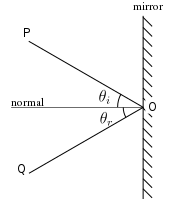
Specular: is the mirror-like reflection of light (or of other kinds of wave) from a surface, in which light from a single incoming direction is reflected into a single outgoing direction. Such behavior is described by the law of reflection, which states that the direction the incident ray), and the direction of the reflected ray make the same angle with respect to the surface normal, thus the angle of incidence equals the angle of reflection (θi = θr in the figure), and that the incident, normal, and reflected directions are coplanar.


Laws of Reflection: There are three laws of reflection

  • The incident ray, the reflected ray and the normal to the reflection surface at the point of the incidence lie in the same plane. 
  • The angle which the incident ray makes with the normal is equal to the angle which the reflected ray makes to the same normal.
  • The reflected ray and the incident ray are on the opposite sides of the normal.
Diffuse: is the reflection of light from a surface such that an incident ray is reflected at many angles rather than at just one angle as in the case of specular reflection. An illuminated ideal diffuse reflecting surface will have equal luminance from all directions in the hemisphere surrounding the surface (Lambertian reflectance).

A surface built from a non-absorbing powder such as plaster, or from fibers such as paper, or from a polycrystalline material such as white marble, reflects light diffusely with great efficiency. Many common materials exhibit a mixture of specular and diffuse reflection.The visibility of objects is primarily caused by diffuse reflection of light: it is diffusely-scattered light that forms the image of the object in the observer's eye.