Days in the Sun

From solstice to solstice, this six month long exposure compresses time from the 21st of June till the 21st of December, 2011, into a single point of view.

Wolf Moon

A full moon looking yellowish-orange, which the ancients and old people dubbed as wolf moon, accompanied by many mythical stories.

A Star Factory

These are the places in the Milky Way galaxy where stars are formed. Awesome, isn't it?

The Ghost Nebula

The Ghost Nebula, after being captured by the Hubble space telescope

Saturn's Iapetus Moon

This is Saturn's Iapetus moon, which looks painted and colorful, setting it apart from the other moons.

Sunday, December 4, 2011

Radioactivity

Radioactivity is the emission of radiations from the nucleus of a radioactive atom. It occurs due to the unstable nucleus of the atom. The nucleus of an atom becomes unstable when the ratio of neutrons to protons is greater than 1.5.

Types of radioactivity: 
Alpha Decay


  1. Alpha Decay:
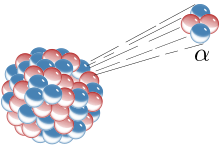
    In an Alpha Decay, the radioactive element emits an alpha particle 'α' or simply a  4
    2
    He2+
    . This results in the decrease of
    atomic number(Z) as well as mass number(A) of the atom.
    The atomic number decrease by 2 and the mass by 2.
  2. Beta Decay:
    β−: In a β− Decay, the nucleus emits an electron and an 
    anti
    neutrino
    .This results in increase of atomic
    number 
    by 1. This happens because the neutron
    in the nucleus converts itself into a proton.

    β+: In a β+ Decay, 
    energy is used to convert a proton into a neutron, while emitting a positron*  and a neutrino.
  3. Neutron Emission: It is a type of radioactive decay of atoms containing excess neutrons, in which a neutron is simply ejected from the nucleus.
The most common radiations from a radioactive element are Alpha particles, Beta particles and Gamma rays(γ). The radioactivity usually starts with an alpha decay then followed by a beta decay and and finally and emission of gamma rays. The excess energy stored in a nucleus when the release of an alpha particle or beta particle is released as gamma radiations.  

Properties of Alpha particles: 
  1. They are positively charged helium 2+ ions.
  2. The are affected by electric fields.
  3. They are heavy.
  4. They penetrate through a body the least.
  5. They ionize the surroundings the most.
  6. Their velocity is 10^4 m/s.
Properties of Beta Particles: 
  1. They are negatively charged particles and are electrons.
  2. They are also affected by electric fields.
  3. They are very light.
  4. They penetrate through a body more than alpha particles but less than Gamma rays
  5. They ionize the surrounding very less when compared with alpha particles.
  6. Their velocity is 10^6 m/s.
Properties of Gamma Rays: 
  1. They are electromagnetic radiations.
  2. They are not affected by electric fields.
  3. They do not have any mass.
  4. They penetrate through the body the most. They can pass through 30cm thick graphite.
  5. They do not ionize the surroundings.
  6. Since they are electromagnetic radiations, their velocity is equal to that of light.

Utilizing the fission energy: Nuclear Reactor

The main use of Nuclear Fission process is in the nuclear reactors. In the nuclear reactors, the heat energy released is utilized and converted into electrical energy. Nuclear Reactors produce energy through controlled fission chain reaction. The process is explained below.

The diagram given here shows the internal part of the nuclear reactor. Its main constituents are 
  1. Containment cell: A cell where the nuclear fuel is kept and is tightly packed with concrete so that no radiations leak out.
  2. Fuel rods: Rods which are made up of radioactive metal and act as fuel.
  3. Control rods: Rods usually made up of cadmium or hafnium which absorb the excess neutrons thus controlling the chain reaction.
  4. Coolant: Usually water. It absorbs the heat liberated and transfers it outside the cell.
  5. Condenser: To condense the coolant.
  6. Inlet and Outlet pipe: Pipes which runs through the condenser to cool the coolant.
  7. Steam Turbine: Turbine used to produce
    electricity from steam.
  8. Steam Generator: A big structure inside the containment cell which contains water.
Working: The reaction is started in the reactor. The reaction releases huge amounts of heat and neutrons. The excess neutrons, which are not required for the reaction, is absorbed by the hafnium of cadmium rods.
The heat released now turns the coolant(water) into its vapour state. Now the coolant is polluted because it was in direct contact with the radioactive element. Thus, this coolant is taken into another chamber. The vapour passes through a tube and reaches the steam generator(the chamber) which also contains water. Now the heat is transferred form the coolant to the water which turns into steam. The coolant now condenses and is pumped back near the fuel. The steam passes through another pipe and reaches the Turbine. The turbine thus spins generating electricity. It produces an AC Voltage, either 11kV to 22kV. The steam now leaves the turbine and enters the condenser. The condenser has inlet and outlet pipes which has continuous supply of cold water. This water cools the steam. The condensed water now falls to the bottom of the condenser which has an inlet to the steam chamber and is pumped into it. 

Nuclear Reactions: Fusion

 When two nuclei are forced into one another, they repel due to electrostatic repulsion between two protons. But when some energy is provided to the nuclei, then the nuclei are able to fuse with each other. The process is called as the nuclear fusion(fusion of nuclei). Thus new elements are formed.In the process, a heavy nucleus, energy and a neutron(usually) is released.
Main uses of nuclear fusion are electric generation and in hydrogen bomb.

Interstellar reactions mainly consist of fusion reactions. The fusion of four hydrogen atoms give rise to an helium atom along with the release of energy and a neutrino. Further fusion leads to formation of heavier elements. Nuclear fusion is the main reaction that runs a star. When the fusion between atoms stops, then the star stops emitting energy and consumes itself.


Nuclear Reactions: Fission


The nucleus of any atom is very unstable. It is due to the presence of neutrons in the nucleus that it becomes very unstable. There are other particles other than neutron and proton in the nucleus. One of those are the neutrinos. These are particles which are responsible for the stable form of the nucleus. Neutrinos are affected only by the weak nuclear forces. 

Thus due to the unstable form of the nucleus, there are two types of reactions which can take place in the nucleus: Nuclear Fission and Nuclear Fusion.

Nuclear Fission: When a heavy nucleus breaks up into two or more nuclei, the reaction is known as nuclear fission. For example: When a neutron is bombarded with a nucleus of a heavy atom like Uranium 235, the product so formed is Krypton(92) and Barium(141) with the release of three neutrons.

Nuclear Fission
Explanation: For atoms with low atomic numbers, a nucleus that has a different number of protons than neutrons can potentially drop to a lower energy state through a radioactive decay that causes the number of protons and neutrons to more closely match. As a result, atoms with roughly matching numbers of protons and neutrons are more stable against decay. However, with increasing atomic number, the mutual repulsion of the protons requires an increasing proportion of neutrons to maintain the stability of the nucleus, which modifies this trend. Thus, there are no stable nuclei with equal proton and neutron numbers above atomic number Z = 20 (calcium); and as Z increases toward the heaviest nuclei, the ratio of neutrons per proton required for stability increases to about 1.5 (1.5 ratio shows instability of the nucleus).

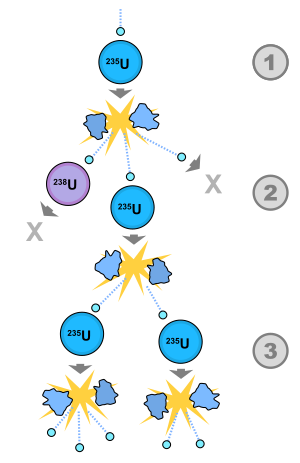
Chain Reaction: Spontaneous fission reactions taking place one after the other is a chain reaction.

Explanation:  When a neutron is made to bombard with a heavy nucleus, the two or more(two is often) products are formed with release of three neutrons. These neutrons can further be used to bombard with three more nucleus and there is release of nine neutrons. This process is continuous and can be controlled as well as uncontrolled. Controlled processes are known as controlled fission reactions and Uncontrolled processes are known as uncontrolled fission reactions.

Fission chain reaction.

The Controlled fission reactions are used in nuclear reactors where cadmium rods are used to absorb the excess neutrons. Thus out of three neutrons, only one is made to bombard with a nucleus and hence the reaction is controlled.

Nucleus

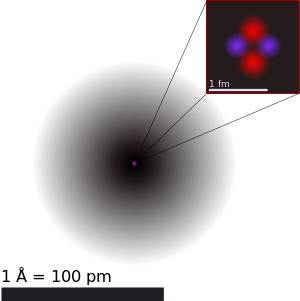
Nucleus is the center of an atom. It is the most dense part of an atom. Nucleus is made of nucleus mainly consisting of neutrons and protons. Almost all of the mass of the nucleus is due to the mass of the nucleus and the electrons contribute only to a part of the atomic mass. Only the nucleus of the Hydrogen atom does not contain neutrons. Rutherford's experiment led to the discovery of nucleus.
The nucleus of an atom is highly unstable. Thus special forces are needed to hold the neutrons and protons together. These forces are very strong in nature and are called strong nuclear forces. Properties of strong nuclear forces are:

  1. They are very strong in nature.
  2. They are of very short range(1-10 fm (femtometer))
  3. They are charge independent
  4. They are attractive in nature.
Composition of the Nucleus: The nucleus of an atom consists of protons and neutrons (two types of baryons) bound by the nuclear force . These baryons are further composed of subatomic fundamental particles known as quarks bound by the strong interaction. Which chemical element an atom represents is determined by the number of protons in the nucleus and its chemical properties are determined by the electrons. Each proton carries a single positive charge, and the total electrical charge of the nucleus is spread fairly uniformly throughout its body, with a fall-off at the edge.


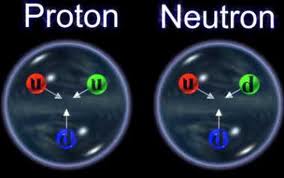
Protons: A Proton carries a net +1 charge on it. A Proton is made up of three quarks. Two up quarks and one  down quark. The 'up' quark carries a net charge of +2/3 and the bottom quark carries a charge of -1/3. Thus the charges add up to give a sum of +1 charge on the proton.

Neutron: A neutron carries no charge on it. A Neutron is also made up of three quarks. One 'up' quark and two 'down' quarks. Thus the net charge is 0.


Sunday, November 6, 2011

Special article: Proton-Proton chain


The proton–proton chain reaction is one of several fusion reactions by which stars convert hydrogen to helium, the primary alternative being the CNO cycle. The proton–proton chain dominates in stars the size of the Sun or smaller.
In general, proton–proton fusion can occur only if the temperature (i.e. kinetic energy) of the protons is high enough to overcome their mutual electrostatic or Coulomb repulsion.
In the Sun, deuterium-producing events are rare enough (the vast majority of these events produces a diproton instead) that a complete conversion of its hydrogen would take more than 1010 (ten billion) years at the prevailing conditions of its core. The fact that the Sun is still shining is due to the slow nature of this reaction; if it went more quickly, the Sun would have exhausted its hydrogen long ago.
The theory that proton–proton reactions were the basic principle by which the Sun and other stars burn was advocated by Arthur Stanley Eddington in the 1920s. At the time, the temperature of the Sun was considered too low to overcome the Coulomb barrier. After the development of quantum mechanics, it was discovered that tunneling of the wave functions of the protons through the repulsive barrier allows for fusion at a lower temperature than the classical prediction.
Even so, it was unclear how proton-proton fusion might proceed, because the most obvious product, helium-2 (diproton), is unstable and immediately dissociates back into a pair of protons. In 1939, Hans Bethe proposed that one of the protons could beta decay into a neutron via the weak interaction during the brief moment of fusion, making deuterium the initial product in the chain. This idea was part of the body of work in stellar nucleosynthesis for which Bethe won the 1967 Nobel Prize in Physics.
The Chain reactions:
The first step involves the fusion of two hydrogen nuclei 1H (protons) into deuterium, releasing a positron and a neutrino as one proton changes into a neutron.
1
1
H
 
+ 1
1
H
 
→ 2
1
D
 
+ e+ + ν
e
 
+ 0.42 MeV
This first step is extremely slow, both because the protons have to tunnel through the Coulomb barrier and because it depends on weak interactions.
The positron immediately annihilates with an electron, and their mass energy, as well as their kinetic energy, is carried off by two gamma ray photons.
e− + e+ → 2 γ + 1.02 MeV
After this, the deuterium produced in the first stage can fuse with another hydrogen to produce a light isotope of helium, 3He:
2
1
D
 
+ 1
1
H
 
→ 3
2
He
 
+ γ + 5.49 MeV
From here there are three possible paths to generate helium isotope 4He. In pp I helium-4 comes from fusing two of the helium-3 nuclei produced; the pp II and pp III branches fuse 3He with a pre-existing 4He to make beryllium. In the Sun, branch pp I takes place with a frequency of 86%, pp II with 14% and pp III with 0.11%. There is also an extremely rare pp IV branch.

The pp I branch

3
2
He
 
+ 3
2
He
 
→ 4
2
He
 
+ 2 1
1
H
 
+ 12.86 MeV
The complete pp I chain reaction releases a net energy of 26.7 MeV. The pp I branch is dominant at temperatures of 10 to 14 MK. Below10 MK, the PP chain does not produce much 4He.

The pp II branch


3
2
He
 
+ 4
2
He
 
→ 7
4
Be
 
+ γ
7
4
Be
 
+ e− → 7
3
Li
 
+ ν
e
 
+ 0.861 MeV / 0.383 MeV
7
3
Li
 
+ 1
1
H
 
→ 2 4
2
He
The pp II branch is dominant at temperatures of 14 to 23 MK.
90% of the neutrinos produced in the reaction 7Be(e−,ν
e
)7Li* carry an energy of 0.861 MeV, while the remaining 10% carry 0.383 MeV (depending on whether lithium-7 is in the ground state or an excited state, respectively).

The pp III branch


3
2
He
 
+ 4
2
He
 
→ 7
4
Be
 
+ γ
7
4
Be
 
+ 1
1
H
 
→ 8
5
B
 
+ γ
8
5
B
 
→ 8
4
Be
 
+ e+ + ν
e
 
+ γ
8
4
Be
 
→ 2 4
2
He
The pp III chain is dominant if the temperature exceeds 23 MK.
The pp III chain is not a major source of energy in the Sun (only 0.11%), but was very important in the solar neutrino problem because it generates very high energy neutrinos (up to 14.06 MeV).

The pp IV or Hep

This reaction is predicted but has never been observed due to its great rarity (about 0.3 ppm in the Sun). In this reaction, Helium-3 reacts directly with a proton to give helium-4, with an even higher possible neutrino energy (up to 18.8 MeV).
3
2
He
 
+ 1
1
H
 
→ 4
2
He
 
+ e+ + ν
e
 
+ 18.8 MeV

Energy release

Comparing the mass of the final helium-4 atom with the masses of the four protons reveals that 0.007 or 0.7% of the mass of the original protons has been lost. This mass has been converted into energy, in the form of gamma rays and neutrinos released during each of the individual reactions. The total energy yield of one whole chain is 26.73 MeV.
Only energy released as gamma rays will interact with electrons and protons and heat the interior of the Sun. This heating supports the Sun and prevents it from collapsing under its own weight.
Neutrinos do not interact significantly with matter and do not help support the Sun against gravitational collapse. The neutrinos in the ppI, ppII and ppIII chains carry away 2.0%, 4.0% and 28.3% of the energy in those reactions respectively.