Days in the Sun

From solstice to solstice, this six month long exposure compresses time from the 21st of June till the 21st of December, 2011, into a single point of view.

Wolf Moon

A full moon looking yellowish-orange, which the ancients and old people dubbed as wolf moon, accompanied by many mythical stories.

A Star Factory

These are the places in the Milky Way galaxy where stars are formed. Awesome, isn't it?

The Ghost Nebula

The Ghost Nebula, after being captured by the Hubble space telescope

Saturn's Iapetus Moon

This is Saturn's Iapetus moon, which looks painted and colorful, setting it apart from the other moons.

Monday, December 5, 2011

Sound

Sound is a form of energy. It is a mechanical wave. It is caused by the vibrations of the particles. Each time a particle vibrates, its vibration excites our ear and the nerve send impulses to our brain and the brain senses it.
Sound propagates in two ways. 1) as a longitudinal wave and 2) as a transverse wave.

Waves: Waves are periodic disturbances in a medium. Energy is carried from one place to another as waves. Thats ones reason waves are used to obtain energy.

Longitudinal Waves: Waves in which particles move along the direction of the wave. Its a simple mechanism.
Lets assume particles of air to be straight lines like these ' |  |  |  |  |  |  |  | '. When particles have to move, they move back and forth like oscillations. There are two stages in movement of particles as longitudinal waves. Compressions and Rarefactions.

Compressions: when the particles move front, the particles in front of them are not in motion. So the particles in motion move very close to them and their vibrations are transferred. Now the particles that are rest start moving. Before the particles move, the particles behind them are very close to them, and are compressed.
                                                           |  |  |  |  |  |  |  |  | | | | | |||||||||| | | | | |  |  |  |  |  |
                                                                                            movement of particles 
                                                                                             ------------>>>>>>


Rarefactions: Now the particles which were in motion from the beginning return back to their original positions. This creates a gap between the particles coming back to their original positions and the particles moving front.
                                                           |  |  |  |  |  |  ||||         |           |         |  |  |  ||||
                                                                     movement of particles
                                                                                             <<<<<<------------
The combination of these two phenomenon is what leads to a longitudinal wave.

Longitudinal Wave


Transverse Waves: Waves in which particles move perpendicular to the direction of propagation of the wave. The simplest example is light wave or any other electromagnetic wave.

Transverse Wave

The ripples on the water are also examples of transverse wave.

Properties of Transverse Waves:

  1. Amplitude(A): It is the maximum displacement of a particle from its mean position.
  2. Oscillation: One complete cycle or vibration or one set of crest and trough.
  3. Frequency: Number of oscillations in one minute. It is measured in hertz(Hz) where 1 Hz = 1 cycle/s 
  4. Time Period(T): Time taken for one oscillation. Time Period and frequency are reciprocals of each other
                                                   
  5. Wavelength( λ): It is the distance between two crests or troughs.

A sounds can be differentiated by its charaterstics. 
Three main characteristics of a Sound wave is: 

  •  Loudness or Intensity:
    Loudness
    is because of greater amplitude. As amplitude increases, the energy of a wave also increases. We can surely differentiate between a loud and a soft sound.It is the magnitude of sound intensity.
    Intensity is the average amount of energy transported per unit area of a surface normal to the direction of propagation.
  • Frequency or Pitch:
    If a waves has a higher frequency, then it is said to be shriller. If its frequency is less, then its said to be feeble. Two sounds of the same loudness or intensity can be differentiated by the difference in their frequency.
    We can differentiate between the sound of 512Hz and 256Hz tuning fork. The 512Hz tuning force is shriller.
  • Timbre or Quality: 
    Two waves of the same loudness and frequency might differ in their wave forms. Timbre is also called tone quality and tone color.
    We can surely distinguish between the sound produced by a violin and a trumpet. It is because of the fact that their wave forms are different.
                          

The Speed of sound is 343.2 m/s in air. In water it is 1497 m/s. In steel, its velocity is 5930 m/s.


Sunday, December 4, 2011

Radioactivity

Radioactivity is the emission of radiations from the nucleus of a radioactive atom. It occurs due to the unstable nucleus of the atom. The nucleus of an atom becomes unstable when the ratio of neutrons to protons is greater than 1.5.

Types of radioactivity
Alpha Decay


  1. Alpha Decay:
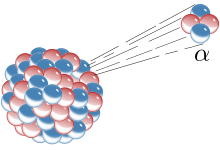
    In an Alpha Decay, the radioactive element emits an alpha particle 'αor simply a  4
    2
    He2+
    . This results in the decrease of
    atomic number(Z) as well as mass number(A) of the atom.
    The atomic number decrease by 2 and the mass by 2.
  2. Beta Decay:
    β: In a β Decay, the nucleus emits an electron and an 
    anti
    neutrino
    .This results in increase of atomic
    number 
    by 1. This happens because the neutron
    in the nucleus converts itself into a proton.

    β+In a βDecay, 
    energy is used to convert a proton into a neutron, while emitting a positron*  and a neutrino.
  3. Neutron Emission: It is a type of radioactive decay of atoms containing excess neutrons, in which a neutron is simply ejected from the nucleus.
The most common radiations from a radioactive element are Alpha particles, Beta particles and Gamma rays(γ)The radioactivity usually starts with an alpha decay then followed by a beta decay and and finally and emission of gamma rays. The excess energy stored in a nucleus when the release of an alpha particle or beta particle is released as gamma radiations.  

Properties of Alpha particles
  1. They are positively charged helium 2+ ions.
  2. The are affected by electric fields.
  3. They are heavy.
  4. They penetrate through a body the least.
  5. They ionize the surroundings the most.
  6. Their velocity is 10^4 m/s.
Properties of Beta Particles
  1. They are negatively charged particles and are electrons.
  2. They are also affected by electric fields.
  3. They are very light.
  4. They penetrate through a body more than alpha particles but less than Gamma rays
  5. They ionize the surrounding very less when compared with alpha particles.
  6. Their velocity is 10^6 m/s.
Properties of Gamma Rays
  1. They are electromagnetic radiations.
  2. They are not affected by electric fields.
  3. They do not have any mass.
  4. They penetrate through the body the most. They can pass through 30cm thick graphite.
  5. They do not ionize the surroundings.
  6. Since they are electromagnetic radiations, their velocity is equal to that of light.

Utilizing the fission energy: Nuclear Reactor

The main use of Nuclear Fission process is in the nuclear reactors. In the nuclear reactors, the heat energy released is utilized and converted into electrical energy. Nuclear Reactors produce energy through controlled fission chain reaction. The process is explained below.

The diagram given here shows the internal part of the nuclear reactor. Its main constituents are 
  1. Containment cell: A cell where the nuclear fuel is kept and is tightly packed with concrete so that no radiations leak out.
  2. Fuel rods: Rods which are made up of radioactive metal and act as fuel.
  3. Control rods: Rods usually made up of cadmium or hafnium which absorb the excess neutrons thus controlling the chain reaction.
  4. Coolant: Usually water. It absorbs the heat liberated and transfers it outside the cell.
  5. Condenser: To condense the coolant.
  6. Inlet and Outlet pipe: Pipes which runs through the condenser to cool the coolant.
  7. Steam Turbine: Turbine used to produce
    electricity from steam.
  8. Steam Generator: A big structure inside the containment cell which contains water.
Working: The reaction is started in the reactor. The reaction releases huge amounts of heat and neutrons. The excess neutrons, which are not required for the reaction, is absorbed by the hafnium of cadmium rods.
The heat released now turns the coolant(water) into its vapour state. Now the coolant is polluted because it was in direct contact with the radioactive element. Thus, this coolant is taken into another chamber. The vapour passes through a tube and reaches the steam generator(the chamber) which also contains water. Now the heat is transferred form the coolant to the water which turns into steam. The coolant now condenses and is pumped back near the fuel. The steam passes through another pipe and reaches the Turbine. The turbine thus spins generating electricity. It produces an AC Voltage, either 11kV to 22kV. The steam now leaves the turbine and enters the condenser. The condenser has inlet and outlet pipes which has continuous supply of cold water. This water cools the steam. The condensed water now falls to the bottom of the condenser which has an inlet to the steam chamber and is pumped into it. 

Nuclear Reactions: Fusion

 When two nuclei are forced into one another, they repel due to electrostatic repulsion between two protons. But when some energy is provided to the nuclei, then the nuclei are able to fuse with each other. The process is called as the nuclear fusion(fusion of nuclei). Thus new elements are formed.In the process, a heavy nucleusenergy and a neutron(usually) is released.
Main uses of nuclear fusion are electric generation and in hydrogen bomb.

Interstellar reactions mainly consist of fusion reactions. The fusion of four hydrogen atoms give rise to an helium atom along with the release of energy and a neutrino. Further fusion leads to formation of heavier elements. Nuclear fusion is the main reaction that runs a star. When the fusion between atoms stops, then the star stops emitting energy and consumes itself.


Nuclear Reactions: Fission


The nucleus of any atom is very unstable. It is due to the presence of neutrons in the nucleus that it becomes very unstable. There are other particles other than neutron and proton in the nucleus. One of those are the neutrinos. These are particles which are responsible for the stable form of the nucleus. Neutrinos are affected only by the weak nuclear forces

Thus due to the unstable form of the nucleus, there are two types of reactions which can take place in the nucleus: Nuclear Fission and Nuclear Fusion.

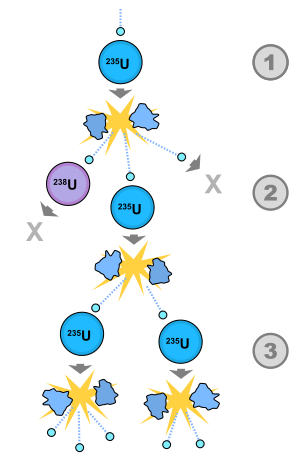
Nuclear Fission: When a heavy nucleus breaks up into two or more nuclei, the reaction is known as nuclear fission. For example: When a neutron is bombarded with a nucleus of a heavy atom like Uranium 235, the product so formed is Krypton(92) and Barium(141) with the release of three neutrons.

Nuclear Fission
ExplanationFor atoms with low atomic numbers, a nucleus that has a different number of protons than neutrons can potentially drop to a lower energy state through a radioactive decay that causes the number of protons and neutrons to more closely match. As a result, atoms with roughly matching numbers of protons and neutrons are more stable against decay. However, with increasing atomic number, the mutual repulsion of the protons requires an increasing proportion of neutrons to maintain the stability of the nucleus, which modifies this trend. Thus, there are no stable nuclei with equal proton and neutron numbers above atomic number Z = 20 (calcium); and as Z increases toward the heaviest nuclei, the ratio of neutrons per proton required for stability increases to about 1.5 (1.5 ratio shows instability of the nucleus).

Chain ReactionSpontaneous fission reactions taking place one after the other is a chain reaction.

Explanation:  When a neutron is made to bombard with a heavy nucleus, the two or more(two is often) products are formed with release of three neutrons. These neutrons can further be used to bombard with three more nucleus and there is release of nine neutrons. This process is continuous and can be controlled as well as uncontrolled. Controlled processes are known as controlled fission reactions and Uncontrolled processes are known as uncontrolled fission reactions.

Fission chain reaction.

The Controlled fission reactions are used in nuclear reactors where cadmium rods are used to absorb the excess neutrons. Thus out of three neutrons, only one is made to bombard with a nucleus and hence the reaction is controlled.

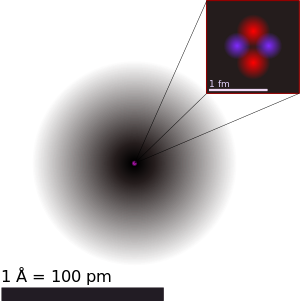
Nucleus

Nucleus is the center of an atom. It is the most dense part of an atom. Nucleus is made of nucleus mainly consisting of neutrons and protons. Almost all of the mass of the nucleus is due to the mass of the nucleus and the electrons contribute only to a part of the atomic mass. Only the nucleus of the Hydrogen atom does not contain neutrons. Rutherford's experiment led to the discovery of nucleus.
The nucleus of an atom is highly unstable. Thus special forces are needed to hold the neutrons and protons together. These forces are very strong in nature and are called strong nuclear forces. Properties of strong nuclear forces are:

  1. They are very strong in nature.
  2. They are of very short range(1-10 fm (femtometer))
  3. They are charge independent
  4. They are attractive in nature.
Composition of the Nucleus: The nucleus of an atom consists of protons and neutrons (two types of baryons) bound by the nuclear force . These baryons are further composed of subatomic fundamental particles known as quarks bound by the strong interaction. Which chemical element an atom represents is determined by the number of protons in the nucleus and its chemical properties are determined by the electrons. Each proton carries a single positive charge, and the total electrical charge of the nucleus is spread fairly uniformly throughout its body, with a fall-off at the edge.


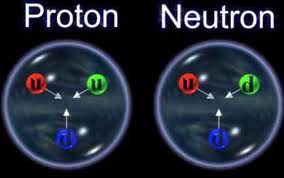
Protons: A Proton carries a net +1 charge on it. A Proton is made up of three quarks. Two up quarks and one  down quark. The 'up' quark carries a net charge of +2/3 and the bottom quark carries a charge of -1/3. Thus the charges add up to give a sum of +1 charge on the proton.

Neutron: A neutron carries no charge on it. A Neutron is also made up of three quarks. One 'up' quark and two 'down' quarks. Thus the net charge is 0.