Days in the Sun

From solstice to solstice, this six month long exposure compresses time from the 21st of June till the 21st of December, 2011, into a single point of view.

Wolf Moon

A full moon looking yellowish-orange, which the ancients and old people dubbed as wolf moon, accompanied by many mythical stories.

A Star Factory

These are the places in the Milky Way galaxy where stars are formed. Awesome, isn't it?

The Ghost Nebula

The Ghost Nebula, after being captured by the Hubble space telescope

Saturn's Iapetus Moon

This is Saturn's Iapetus moon, which looks painted and colorful, setting it apart from the other moons.

Friday, December 9, 2011

Special article: Di-proton

A diproton (or helium-2, symbol 2He) is a hypothetical isotope of helium nucleus consisting of two protons and no neutrons, and is predicted to be less stable than 5He. Diprotons are not stable; this is due to spin-spin interactions in the nuclear force, and the Pauli exclusion principle, which forces the two protons to have anti-aligned spins and gives the diproton a negative binding energy.


In 2000, physicists first observed a new type of radioactive decay in which a nucleus emits two protons at once - perhaps a 2He nucleus.The team led by Alfredo Galindo-Uribarri of the Oak Ridge National Laboratory announced that the discovery will help scientists understand the strong nuclear force and provide fresh insights into the creation of elements inside stars. Galindo-Uribarri and co-workers chose an isotope of neon with an energy structure that prevents it from emitting protons one at a time. This means that the two protons are ejected simultaneously. The team fired a beam of fluorine ions at a proton-rich target to produce 18Ne, which then decays into oxygen and two protons. Any protons ejected from the target itself were identified by their characteristic energies. There are two ways in which the two-proton emission may proceed. The neon nucleus might eject a 'diproton' - a pair of protons bound together as a 2He nucleus - which then decays into separate protons. Alternatively, the protons may be emitted separately but at the same time - so-called 'democratic decay'. The experiment was not sensitive enough to establish which of these two processes was taking place.
The best evidence of 2He was found in 2008 at the Istituto Nazionale di Fisica Nucleare, in Italy. A beam of 20Ne ions was collided into a foil of beryllium. In this collision some of the neon ended up as 18Ne nuclei. These same nuclei then collided with a foil of lead. The second collision had the effect of exciting the 18Ne nucleus into a highly unstable condition. As in the earlier experiment at Oak Ridge, the 18Nenucleus decayed into an 16O nucleus, plus two protons detected exiting from the same direction. The new experiment showed that the two protons were initially ejected together before decaying into separate protons much less than a billionth of a second later.
Also, at RIKEN in Japan and JINR in Dubna, Russia, during productions of 5He with collisions between a beam of 6He nuclei and a cryogenic hydrogen target, it was discovered that the 6He nucleus can donate all four of its neutrons to the hydrogen. This leaves two spare protons that may be simultaneously ejected from the target as a 2He nucleus, which quickly decays into two protons. A similar reaction has also been observed from 8He nuclei colliding with hydrogen.

Monday, December 5, 2011

Resonance of waves

A Wave has characteristic features like amplitude, frequency etc.. Now the amplitude of a wave can be increased without increasing the frequency or the frequency can be increased without increasing the amplitude. The increase in amplitude with the increase in frequency is resonance(not the actual definition).

Resonance occurs when the frequencies of two bodies match.

Examples:

  1.  When a vibrating tuning fork is kept on a surface of  wood, we hear a loud sound. This is because of resonance. The amplitude of the fork increases suddenly and thus we hear a louder sound.
  2. When loud bass(pronounced as 'base') music is played, the glasses around you start vibrating.
  3. If you take two guitars both tuned the same and place them side by side, when you pluck the A string on one guitar you will see the A string on the other guitar start to vibrate as well. 
  4. When two pendulums of the same length are kept next to each other and one of the pendulum is made to vibrate, then the other pendulum also vibrates.
These are simple examples of resonance.

Sound

Sound is a form of energy. It is a mechanical wave. It is caused by the vibrations of the particles. Each time a particle vibrates, its vibration excites our ear and the nerve send impulses to our brain and the brain senses it.
Sound propagates in two ways. 1) as a longitudinal wave and 2) as a transverse wave.

Waves: Waves are periodic disturbances in a medium. Energy is carried from one place to another as waves. Thats ones reason waves are used to obtain energy.

Longitudinal Waves: Waves in which particles move along the direction of the wave. Its a simple mechanism.
Lets assume particles of air to be straight lines like these ' |  |  |  |  |  |  |  | '. When particles have to move, they move back and forth like oscillations. There are two stages in movement of particles as longitudinal waves. Compressions and Rarefactions.

Compressions: when the particles move front, the particles in front of them are not in motion. So the particles in motion move very close to them and their vibrations are transferred. Now the particles that are rest start moving. Before the particles move, the particles behind them are very close to them, and are compressed.
                                                           |  |  |  |  |  |  |  |  | | | | | |||||||||| | | | | |  |  |  |  |  |
                                                                                            movement of particles 
                                                                                             ------------>>>>>>


Rarefactions: Now the particles which were in motion from the beginning return back to their original positions. This creates a gap between the particles coming back to their original positions and the particles moving front.
                                                           |  |  |  |  |  |  ||||         |           |         |  |  |  ||||
                                                                     movement of particles
                                                                                             <<<<<<------------
The combination of these two phenomenon is what leads to a longitudinal wave.

Longitudinal Wave


Transverse Waves: Waves in which particles move perpendicular to the direction of propagation of the wave. The simplest example is light wave or any other electromagnetic wave.

Transverse Wave

The ripples on the water are also examples of transverse wave.

Properties of Transverse Waves:

  1. Amplitude(A): It is the maximum displacement of a particle from its mean position.
  2. Oscillation: One complete cycle or vibration or one set of crest and trough.
  3. Frequency: Number of oscillations in one minute. It is measured in hertz(Hz) where 1 Hz = 1 cycle/s 
  4. Time Period(T): Time taken for one oscillation. Time Period and frequency are reciprocals of each other
                                                   
  5. Wavelength( λ): It is the distance between two crests or troughs.

A sounds can be differentiated by its charaterstics. 
Three main characteristics of a Sound wave is: 

  •  Loudness or Intensity:
    Loudness
    is because of greater amplitude. As amplitude increases, the energy of a wave also increases. We can surely differentiate between a loud and a soft sound.It is the magnitude of sound intensity.
    Intensity is the average amount of energy transported per unit area of a surface normal to the direction of propagation.
  • Frequency or Pitch:
    If a waves has a higher frequency, then it is said to be shriller. If its frequency is less, then its said to be feeble. Two sounds of the same loudness or intensity can be differentiated by the difference in their frequency.
    We can differentiate between the sound of 512Hz and 256Hz tuning fork. The 512Hz tuning force is shriller.
  • Timbre or Quality: 
    Two waves of the same loudness and frequency might differ in their wave forms. Timbre is also called tone quality and tone color.
    We can surely distinguish between the sound produced by a violin and a trumpet. It is because of the fact that their wave forms are different.
                          

The Speed of sound is 343.2 m/s in air. In water it is 1497 m/s. In steel, its velocity is 5930 m/s.


Sunday, December 4, 2011

Radioactivity

Radioactivity is the emission of radiations from the nucleus of a radioactive atom. It occurs due to the unstable nucleus of the atom. The nucleus of an atom becomes unstable when the ratio of neutrons to protons is greater than 1.5.

Types of radioactivity: 
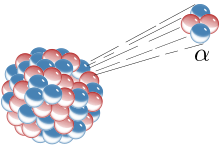
Alpha Decay


  1. Alpha Decay:
    In an Alpha Decay, the radioactive element emits an alpha particle 'α' or simply a  4
    2
    He2+
    . This results in the decrease of
    atomic number(Z) as well as mass number(A) of the atom.
    The atomic number decrease by 2 and the mass by 2.
  2. Beta Decay:
    β−: In a β− Decay, the nucleus emits an electron and an 
    anti
    neutrino
    .This results in increase of atomic
    number 
    by 1. This happens because the neutron
    in the nucleus converts itself into a proton.

    β+: In a β+ Decay, 
    energy is used to convert a proton into a neutron, while emitting a positron*  and a neutrino.
  3. Neutron Emission: It is a type of radioactive decay of atoms containing excess neutrons, in which a neutron is simply ejected from the nucleus.
The most common radiations from a radioactive element are Alpha particles, Beta particles and Gamma rays(γ). The radioactivity usually starts with an alpha decay then followed by a beta decay and and finally and emission of gamma rays. The excess energy stored in a nucleus when the release of an alpha particle or beta particle is released as gamma radiations.  

Properties of Alpha particles: 
  1. They are positively charged helium 2+ ions.
  2. The are affected by electric fields.
  3. They are heavy.
  4. They penetrate through a body the least.
  5. They ionize the surroundings the most.
  6. Their velocity is 10^4 m/s.
Properties of Beta Particles: 
  1. They are negatively charged particles and are electrons.
  2. They are also affected by electric fields.
  3. They are very light.
  4. They penetrate through a body more than alpha particles but less than Gamma rays
  5. They ionize the surrounding very less when compared with alpha particles.
  6. Their velocity is 10^6 m/s.
Properties of Gamma Rays: 
  1. They are electromagnetic radiations.
  2. They are not affected by electric fields.
  3. They do not have any mass.
  4. They penetrate through the body the most. They can pass through 30cm thick graphite.
  5. They do not ionize the surroundings.
  6. Since they are electromagnetic radiations, their velocity is equal to that of light.

Utilizing the fission energy: Nuclear Reactor

The main use of Nuclear Fission process is in the nuclear reactors. In the nuclear reactors, the heat energy released is utilized and converted into electrical energy. Nuclear Reactors produce energy through controlled fission chain reaction. The process is explained below.

The diagram given here shows the internal part of the nuclear reactor. Its main constituents are 
  1. Containment cell: A cell where the nuclear fuel is kept and is tightly packed with concrete so that no radiations leak out.
  2. Fuel rods: Rods which are made up of radioactive metal and act as fuel.
  3. Control rods: Rods usually made up of cadmium or hafnium which absorb the excess neutrons thus controlling the chain reaction.
  4. Coolant: Usually water. It absorbs the heat liberated and transfers it outside the cell.
  5. Condenser: To condense the coolant.
  6. Inlet and Outlet pipe: Pipes which runs through the condenser to cool the coolant.
  7. Steam Turbine: Turbine used to produce
    electricity from steam.
  8. Steam Generator: A big structure inside the containment cell which contains water.
Working: The reaction is started in the reactor. The reaction releases huge amounts of heat and neutrons. The excess neutrons, which are not required for the reaction, is absorbed by the hafnium of cadmium rods.
The heat released now turns the coolant(water) into its vapour state. Now the coolant is polluted because it was in direct contact with the radioactive element. Thus, this coolant is taken into another chamber. The vapour passes through a tube and reaches the steam generator(the chamber) which also contains water. Now the heat is transferred form the coolant to the water which turns into steam. The coolant now condenses and is pumped back near the fuel. The steam passes through another pipe and reaches the Turbine. The turbine thus spins generating electricity. It produces an AC Voltage, either 11kV to 22kV. The steam now leaves the turbine and enters the condenser. The condenser has inlet and outlet pipes which has continuous supply of cold water. This water cools the steam. The condensed water now falls to the bottom of the condenser which has an inlet to the steam chamber and is pumped into it. 

Nuclear Reactions: Fusion

 When two nuclei are forced into one another, they repel due to electrostatic repulsion between two protons. But when some energy is provided to the nuclei, then the nuclei are able to fuse with each other. The process is called as the nuclear fusion(fusion of nuclei). Thus new elements are formed.In the process, a heavy nucleus, energy and a neutron(usually) is released.
Main uses of nuclear fusion are electric generation and in hydrogen bomb.

Interstellar reactions mainly consist of fusion reactions. The fusion of four hydrogen atoms give rise to an helium atom along with the release of energy and a neutrino. Further fusion leads to formation of heavier elements. Nuclear fusion is the main reaction that runs a star. When the fusion between atoms stops, then the star stops emitting energy and consumes itself.