Days in the Sun

From solstice to solstice, this six month long exposure compresses time from the 21st of June till the 21st of December, 2011, into a single point of view.

Wolf Moon

A full moon looking yellowish-orange, which the ancients and old people dubbed as wolf moon, accompanied by many mythical stories.

A Star Factory

These are the places in the Milky Way galaxy where stars are formed. Awesome, isn't it?

The Ghost Nebula

The Ghost Nebula, after being captured by the Hubble space telescope

Saturn's Iapetus Moon

This is Saturn's Iapetus moon, which looks painted and colorful, setting it apart from the other moons.

Monday, February 6, 2012

Magnetosphere

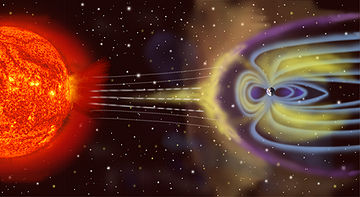
Artistic rendition(not real)
magnetosphere is formed when a stream of charged particles, such as the solar wind, interacts with and is deflected by the intrinsic magnetic field of a planet or similar body. Earth is surrounded by a magnetosphere, as are the other planets with intrinsic magnetic fields: MercuryJupiterSaturnUranus, and Neptune. Jupiter's moon Ganymede has a small magnetosphere — but it is situated entirely within the magnetosphere of Jupiter, leading to complex interactions. The ionospheres of weakly magnetized planets such as Venus and Mars set up currents that partially deflect the solar wind flow, but do not have magnetospheres.


Earth's Magnetosphere:

The magnetosphere of Earth is a region in space whose shape is determined by the Earth's internal magnetic field, the solar wind plasma, and the interplanetary magnetic field (IMF). The boundary of the magnetosphere ("magnetopause") is roughly bullet shaped, about 15 RE abreast of Earth and on the night side (in the "magnetotail" or "geotail") approaching a cylinder with a radius 20-25 RE. The tail region stretches well past 200 RE, and the way it ends is not well known.
The outer neutral gas envelope of Earth, or geocorona, consists mostly of the lightest atoms, hydrogen and helium, and continues beyond 4-5 RE, with diminishing density. The hot plasma ions of the magnetosphere acquire electrons during collisions with these atoms and create an escaping "glow" of energetic neutral atoms (ENAs) that have been used to image the hot plasma clouds by the IMAGE and TWINS missions.
The upward extension of the ionosphere, known as the plasmasphere, also extends beyond 4-5 RE with diminishing density, beyond which it becomes a flow of light ions called the polar wind that escapes out of the magnetosphere into the solar wind. Energy deposited in the ionosphere by auroras strongly heats the heavier atmospheric components such as oxygen and molecules of oxygen and nitrogen, which would not otherwise escape from Earth's gravity. Owing to this highly variable heating, however, a heavy atmospheric or ionospheric outflow of plasma flows during disturbed periods from the auroral zones into the magnetosphere, extending the region dominated by terrestrial material, known as the fourth or plasma geosphere, at times out to the magnetopause.
Earth’s magnetosphere protects the ozone layer from the solar wind. The ozone layer protects the Earth (and life on it) from dangerous ultraviolet radiation.

Sunday, February 5, 2012

Earth as a Magnet

The Earth, like all other magnets also has its own magnetic field that extends from the inner core to outer space. Earth's core as we have studied it to be, is made up of molten iron and other metals which are in liquid state which is a very good conductor. The Earth's magnetic field is like no other permanent magnet because its polarity keeps changing.  At random intervals the Earth's field reverses (the north and south geomagnetic poles change places with each other). These reversals leave a record in rocks that allow paleomagnetists to calculate past motions of continents and ocean floors as a result of plate tectonics. Good for us that these reversals take about a million years to slowly reverse.

OriginThe Earth's magnetic field is mostly caused by electric currents in the liquid outer core, which is composed of highly conductive molten iron.The motion of the fluid is sustained by convection, motion driven by buoyancy. The temperature increases towards the center of the Earth, and the higher temperature of the fluid lower down makes it buoyant. This buoyancy is enhanced by chemical separation: As the core cools, some of the molten iron solidifies and is plated to the inner core. In the process, lighter elements are left behind in the fluid, making it lighter. This is called compositional convection. A Coriolis effect, caused by the overall planetary rotation, tends to organize the flow into rolls aligned along the north-south polar axis.

Approximations:
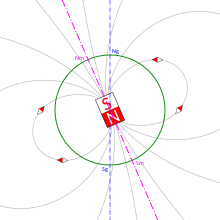
Near the surface of the Earth, its magnetic field can be closely approximated by the field of a magnetic dipole positioned at the center of the Earth and tilted at an angle of about 11° with respect to the rotational axis of the Earth. The dipole is roughly equivalent to a powerful bar-magnet, with its south pole pointing towards the geomagnetic North Pole. This may seem surprising, but the north pole of a magnet is so defined because it is attracted towards the Earth's north pole. Since the north pole of a magnet attracts the south poles of other magnets and repels the north poles, it must be attracted to the south pole of Earth's magnet. The dipolar field accounts for 80–90% of the field in most locations.


Measurement of IntensityThe intensity of the field is greatest near the poles and weaker near the Equator. It is generally reported in nanoteslas (nT) or gauss, with 1 gauss = 100,000 nT. It ranges from about25,000–65,000 nT, or 0.25–0.65 gauss. By comparison, a strong refrigerator magnet has a field of about 100 gauss.
The average magnetic field in the Earth's outer core was calculated to be 25 Gauss, 50 times stronger than the field at the surface.

Importance:
Humans have used compasses for direction finding since the 11th century A.D. and for navigation since the 12th century.
The polarity of the Earth's magnetic field is recorded in sedimentary rocks. 
The Earth is largely protected from the solar wind, a stream of energetic charged particles emanating from the Sun, by its magnetic field, which deflects most of the charged particles. These particles would strip away the ozone layer, which protects the Earth from harmful ultraviolet rays.Calculations of the loss of carbon dioxide from the atmosphere of Mars, resulting from scavenging of ions by the solar wind, are consistent with a near-total loss of its atmosphere since the magnetic field of Mars turned off.
This field that protects us is called the magnetosphere.

Saturday, February 4, 2012

Magnetism

Magnetism is a property of materials that respond at an atomic or subatomic level to an applied magnetic fieldFerromagnetism is the strongest and most familiar type of magnetism. It is responsible for the behavior of permanent magnets, which produce their own persistent magnetic fields, as well as the materials that are attracted to them.


Magnetism, at its root, arises from two sources:
  1. Electric currents or more generally, moving electric charges create magnetic fields (see Maxwell's Equations).
  2. Many particles have nonzero "intrinsic" or "spin" magnetic moments. Just as each particle, by its nature, has a certain mass and charge, each has a certain magnetic moment, possibly zero.
In magnetic materials, sources of magnetization are the electrons' orbital angular motion around the nucleus, and the electrons' intrinsic magnetic moment (see electron magnetic dipole moment). The other sources of magnetism are the nuclear magnetic moments of the nuclei in the material which are typically thousands of times smaller than the electrons' magnetic moments, so they are negligible in the context of the magnetization of materials. Nuclear magnetic moments are important in other contexts, particularly in nuclear magnetic resonance (NMR) and magnetic resonance imaging (MRI).
Ordinarily, the enormous number of electrons in a material are arranged such that their magnetic moments (both orbital and intrinsic) cancel out. This is due, to some extent, to electrons combining into pairs with opposite intrinsic magnetic moments as a result of the Pauli exclusion principle (see electron configuration), or combining into filled subshells with zero net orbital motion. In both cases, the electron arrangement is so as to exactly cancel the magnetic moments from each electron. Moreover, even when the electron configuration is such that there are unpaired electrons and/or non-filled subshells, it is often the case that the various electrons in the solid will contribute magnetic moments that point in different, random directions, so that the material will not be magnetic.
However, sometimes either spontaneously, or owing to an applied external magnetic field — each of the electron magnetic moments will be, on average, lined up. Then the material can produce a net total magnetic field, which can potentially be quite strong.
The magnetic behavior of a material depends on its structure, particularly its electron configuration, for the reasons mentioned above, and also on the temperature. At high temperatures, random thermal motion makes it more difficult for the electrons to maintain alignment.
Diamagnetism:
Diamagnetism appears in all materials, and is the tendency of a material to oppose an applied magnetic field, and therefore, to be repelled by a magnetic field. Diamagnetic behavior is observed only in a purely diamagnetic material. In a diamagnetic material, there are no unpaired electrons, so the intrinsic electron magnetic moments cannot produce any bulk effect.
Paramagnetism:
In a paramagnetic material there are unpaired electrons, i.e. atomic or molecular orbitals with exactly one electron in them. While paired electrons are required by the Pauli exclusion principle to have their intrinsic (spin) magnetic moments pointing in opposite directions, causing their magnetic fields to cancel out, an unpaired electron is free to align its magnetic moment in any direction. When an external magnetic field is applied, these magnetic moments will tend to align themselves in the same direction as the applied field, thus reinforcing it.
Ferromagnetism:
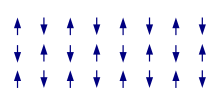
A ferromagnet, like a paramagnetic substance, has unpaired electrons. However, in addition to the electrons' intrinsic magnetic moment's tendency to be parallel to an applied field, there is also in these materials a tendency for these magnetic moments to orient parallel to each other to maintain a lowered-energy state. Thus, even when the applied field is removed, the electrons in the material maintain a parallel orientation.
Every ferromagnetic substance has its own individual temperature, called the Curie temperature, or Curie point, above which it loses its ferromagnetic properties. This is because the thermal tendency to disorder overwhelms the energy-lowering due to ferromagnetic order.
Some well-known ferromagnetic materials that exhibit easily detectable magnetic properties (to form magnets) are nickel, iron, cobalt, gadolinium and their alloys.


Antiferromagnetism:
In an antiferromagnet, unlike a ferromagnet, there is a tendency for the intrinsic magnetic moments of neighboring valence electrons to point in opposite directions. When all atoms are arranged in a substance so that each neighbor is 'anti-aligned', the substance is antiferromagnetic. Antiferromagnets have a zero net magnetic moment, meaning no field is produced by them. Antiferromagnets are less common compared to the other types of behaviors, and are mostly observed at low temperatures. In varying temperatures, antiferromagnets can be seen to exhibit diamagnetic and ferrimagnetic properties.
In some materials, neighboring electrons want to point in opposite directions, but there is no geometrical arrangement in which each pair of neighbors is anti-aligned. This is called a spin glass, and is an example of geometrical frustration.

Ferrimagnetism:
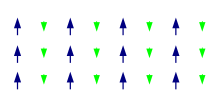
Like ferromagnetism, ferrimagnets retain their magnetization in the absence of a field. However, like antiferromagnets, neighboring pairs of electron spins like to point in opposite directions. These two properties are not contradictory, because in the optimal geometrical arrangement, there is more magnetic moment from the sublattice of electrons that point in one direction, than from the sublattice that points in the opposite direction.
The first discovered magnetic substance, magnetite, was originally believed to be a ferromagnet. It was later disproved.
Electromagnet:

An electromagnet is a type of magnet whose magnetism is produced by the flow of electric current. The magnetic field disappears when the current ceases.


Friday, February 3, 2012

Generating Electricity: From the Sun


Before you're able to produce electricity through solar energy, there needs to be some form of solar cell or panel that will be used to absorb the sun's energy. Solar panels are constructed from a semi-conductive material with the most common material of choice being silicon. The semi-conductive material contains electrons which will naturally just stay there not doing anything.
When photons (contained within the suns rays) hit a solar cell, the electrons contained in the solar cell material absorb this solar energy, which transforms the electrons into conduction electrons. If the energy of these photons is great enough then the electrons are able to become free and carry an electric charge through a circuit to the destination.

Thursday, February 2, 2012

Generating Electricity: From Coal

Coal plays a vital role in electricity generation worldwide. Coal-fired power plants currently fuel 41% of global electricity. In some countries, coal fuels a higher percentage of electricity.


Steam coal, also known as thermal coal, is used in power stations to generate electricity.
Coal is first milled to a fine powder, which increases the surface area and allows it to burn more quickly. In these pulverised coal combustion (PCC) systems, the powdered coal is blown into the combustion chamber of a boiler where it is burnt at high temperature . The hot gases and heat energy produced converts water – in tubes lining the boiler – into steam.
The high pressure steam is passed into a turbine containing thousands of propeller-like blades. The steam pushes these blades causing the turbine shaft to rotate at high speed. A generator is mounted at one end of the turbine shaft and consists of carefully wound wire coils. Electricity is generated when these are rapidly rotated in a strong magnetic field. After passing through the turbine, the steam is condensed and returned to the boiler to be heated once again.
The electricity generated is transformed into the higher voltages (up to 400,000 volts) used for economic, efficient transmission via power line grids. When it nears the point of consumption, such as our homes, the electricity is transformed down to the safer 100-250 voltage systems used in the domestic market.


A coal-fired power plant in Laughlin,
Nevada U.S.A. Owners of this plant
ceased operations after declining to invest in
 pollution control equipment to comply with pollution regulations.

Wednesday, February 1, 2012

Generating Electricity: From water

There is no life without electricity. Thus man had to find out ways to produce electricity on large scales so as to provide electricity to everyone. Many ways were found to produce electricity but the easiest way to produce was using water. Water which flows carries a huge amount of potential energy which can be converted into electrical energy.
The basic idea was to make fall on a magnetic turbine from a great height or to simply let water flow form a higher ground to lower ground and to increase its velocity.

How it works:
A hydraulic turbine converts the energy of flowing water into mechanical energy. A hydroelectric generator converts this mechanical energy into electricity. The operation of a generator is based on the principles discovered by Faraday. He found that when a magnet is moved past a conductor, it causes electricity to flow. In a large generator, electromagnets are made by circulating direct current through loops of wire wound around stacks of magnetic steel laminations. These are called field poles, and are mounted on the perimeter of the rotor. The rotor is attached to the turbine shaft, and rotates at a fixed speed. When the rotor turns, it causes the field poles (the electromagnets) to move past the conductors mounted in the stator. This, in turn, causes electricity to flow and a voltage to develop at the generator output terminals.

At times of low demand of electricity, excess electricity is utilized for another day's produce. This is called Pumped Storage.

Pumped StoragePumped storage is a method of keeping water in reserve for peak period power demands by pumping water that has already flowed through the turbines back up a storage pool above the power plant at a time when customer demand for energy is low, such as during the middle of the night. The water is then allowed to flow back through the turbine-generators at times when demand is high and a heavy load is placed on the system.
The reservoir acts much like a battery, storing power in the form of water when demands are low and producing maximum power during daily and seasonal peak periods. An advantage of pumped storage is that hydroelectric generating units are able to start up quickly and make rapid adjustments in output. They operate efficiently when used for one hour or several hours. Because pumped storage reservoirs are relatively small, construction costs are generally low compared with conventional hydropower facilities.