Days in the Sun

From solstice to solstice, this six month long exposure compresses time from the 21st of June till the 21st of December, 2011, into a single point of view.

Wolf Moon

A full moon looking yellowish-orange, which the ancients and old people dubbed as wolf moon, accompanied by many mythical stories.

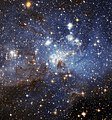
A Star Factory

These are the places in the Milky Way galaxy where stars are formed. Awesome, isn't it?

The Ghost Nebula

The Ghost Nebula, after being captured by the Hubble space telescope

Saturn's Iapetus Moon

This is Saturn's Iapetus moon, which looks painted and colorful, setting it apart from the other moons.

Sunday, May 20, 2012

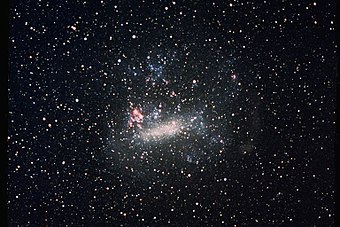
Large Magellanic Cloud


The Large Magellanic Cloud (LMC) is a nearby irregular galaxy, and is a satellite of the Milky Way. At a distance of slightly less than 50 kiloparsecs (≈160,000 light-years), the LMC is the third closest galaxy to the Milky Way, with the Sagittarius Dwarf Spheroidal (~ 16 kiloparsecs) and Canis Major Dwarf Galaxy (~ 12.9 kiloparsecs) lying closer to the center of the Milky Way. It has a mass equivalent to approximately 10 billion times the mass of our Sun (1010 solar masses), making it roughly 1/100 as massive as the Milky Way, and a diameter of about 14,000 light-years (~ 4.3 kpc). The LMC is the fourth largest galaxy in the Local Group, the first, second and third largest being Andromeda Galaxy , our own Milky Way Galaxy, and  the Triangulum Galaxy.
While the LMC is often considered an irregular type galaxy (the NASA Extragalactic Database lists the Hubble sequence type as Irr/SB(s)m), the LMC contains a very prominent bar in its center, suggesting that it may have previously been a barred spiral galaxy. The LMC's irregular appearance is possibly the result of tidal interactions with both the Milky Way, and the Small Magellanic Cloud (SMC).
It is visible as a faint "cloud" in the night sky of the southern hemisphere straddling the border between the constellations of Dorado and Mensa.
The very first recorded mention of the Large Magellanic Cloud was by the Persian astronomer, `Abd al-Rahman al-Sufi (later known in Europe as "Azophi"), in his Book of Fixed Stars around 964 AD.
The next recorded observation was in 1503–4 by Amerigo Vespucci in a letter about his third voyage. In this letter he mentions "three Canopes, two bright and one obscure"; "bright" refers to the two Magellanic Clouds, and "obscure" refers to the Coalsack.
Ferdinand Magellan sighted the LMC on his voyage in 1519, and his writings brought the LMC into common Western knowledge. The galaxy now bears his name

Other images of LMC:


Infrared Image

Sunday, May 6, 2012

Critical Angle

Critical angle is the angle at which the light ray travelling form a denser medium to a rarer medium grazes along the surface rather than escaping directly. The angle of refraction in 90° for the angle of incidence equal to critical angle. A ray of light which is incident of the boundary separating the two optical mediums is incident at angle greater than critical angle will get reflected. This phenomenon is called Total Internal Reflection.


The angle of incidence is measured with respect to the normal at the refractive boundary (see diagram illustrating Snell's law). Consider a light ray passing from glass into air. The light emanating from the interface is bent towards the glass. When the incident angle is increased sufficiently, the transmitted angle (in air) reaches 90 degrees. It is at this point no light is transmitted into air. The critical angle \theta_c is given by Snell's law,

n_1\sin\theta_i = n_2\sin\theta_t \quad.
Rearranging Snell's Law, we get incidence
\sin \theta_i = \frac{n_2}{n_1} \sin \theta_t.
To find the critical angle, we find the value for \theta_i when \theta_t = 90° and thus \sin \theta_t = 1. The resulting value of \theta_i is equal to the critical angle \theta_c.
Now, we can solve for \theta_i, and we get the equation for the critical angle:
\theta_c = \theta_i = \arcsin \left( \frac{n_2}{n_1} \right),
If the incident ray is precisely at the critical angle, the refracted ray is tangent to the boundary at the point of incidence. If for example, visible light were traveling through acrylic glass (with an index of refraction of 1.50) into air (with an index of refraction of 1.00), the calculation would give the critical angle for light from acrylic into air, which is
\theta _{c}=\arcsin \left( \frac{1.00}{1.50} \right)=41.8{}^\circ .
Light incident on the border with an angle less than 41.8° would be partially transmitted, while light incident on the border at larger angles with respect to normal would be totally internally reflected.
If the fraction {n_2}/{n_1} is greater than 1, then arcsine is not defined—meaning that total internal reflection does not occur even at very shallow or grazing incident angles.
So the critical angle is only defined when {n_2}/{n_1} is less than 1.

How does our phone Vibrate?


There is a device that takes vibration to high-tech extremes. Any parent whose child owns a Tickle-Me-Elmo doll has experienced this technology. Elmo has a vibration system (designed to simulate body-shaking laughter) that is powerful enough to cause many children to drop the toy. The vibration system inside a pager works exactly the same way on a smaller scale, so let's use Elmo as an example.
Inside the control unit (on the right hand side in the above image) is a small DC motor which drives this gear:You can see that, attached to the gear, there is a small weight. This weight is about the size of a stack of 5 U.S. nickels, and it is mounted off-center on the gear. When the motor spins the gear/weight combination (at 100 to 150 RPM), the off-center mounting causes a strong vibration. Inside a cell phone or pager there is the same sort of mechanism in a much smaller version
.

Sunday, April 15, 2012

UV rays


Ultraviolet (UV) light is electromagnetic radiation with a wavelength shorter than that of visible light, but longer than X-rays, in the range 10 nm to 400 nm, and energies from 3 eV to 124 eV. It is named because the spectrum consists of electromagnetic waves with frequencies higher than those that humans identify as the colour violet. These frequencies are invisible to humans, but visible to a number of insects and birds. They are also indirectly visible, by causing fluorescent materials to glow with visible light.
UV light is found in sunlight and is emitted by electric arcs and specialized lights such as black lights. It can cause chemical reactions, and causes many substances to glow or fluoresce. Most ultraviolet is classified as non-ionizing radiation. The higher energies of the ultraviolet spectrum from wavelengths about 10 nm to 120 nm ('extreme' ultraviolet) are ionizing, but this type of ultraviolet in sunlight is blocked by normal dioxygen in air, and does not reach the ground.However, the entire spectrum of ultraviolet radiation has some of the biological features of ionizing radiation, in doing far more damage to many molecules in biological systems than is accounted for by simple heating effects (an example is sunburn). These properties derive from the ultraviolet photon's power to alter chemical bonds in molecules, even without having enough energy to ionize atoms.
Sun as seen by UV light

Although ultraviolet radiation is invisible to the human eye, most people are aware of the effects of UV through sunburn, and in tanning beds. A great deal (>97%) of mid-range ultraviolet (almost all UV above 280 nm and most above 315 nm) is blocked by the ozone layer, and would cause much damage to living organisms if it penetrated the atmosphere. What remains of ultraviolet in sunlight after atmospheric filtering is responsible for the formation of vitamin D (peak production occurring between 295 and 297 nm) in all organisms that make this vitamin (including humans). The UV spectrum thus has many effects, both beneficial and damaging, to human health.

Sun a Natural Source: The sun emits ultraviolet radiation in the UVA, UVB, and UVC bands. The Earth's ozone layer blocks 97–99% of this UV radiation from penetrating through the atmosphere. Of the ultraviolet radiation that reaches the Earth's surface, 98.7% is UVA. (UVC and more energetic radiation is responsible for the generation of the ozone layer, and formation of the ozone there). Extremely hot stars emit proportionally more UV radiation than the sun; the star R136a1 has a thermal energy of 4.57 eV, which falls in the near-UV range.
Ordinary glass is partially transparent to UVA but is opaque to shorter wavelengths, whereas silica or quartz glass, depending on quality, can be transparent even to vacuum UV wavelengths. Ordinary window glass passes about 90% of the light above 350 nm, but blocks over 90% of the light below 300 nm.
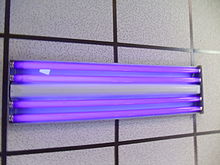
UV fluorescent lamps: Fluorescent lamps without a phosphorescent coating to convert UV to visible light, emit ultraviolet light with two peaks at 253.7 nm and 185 nm due to the peak emission of the mercury within the bulb. Eighty-five to ninety percent of the UV produced by these lamps is at 253.7 nm, while only five to ten percent is at 185 nm. Germicidal lamps use quartz (glass) doped with an additive to block the 185 nm wavelength. With the addition of a suitable phosphor (phosphorescent coating), they can be modified to produce a UVA, UVB, or visible light spectrum (all fluorescent tubes used for domestic and commercial lighting are mercury UV emission bulbs at heart).
Fluorescent Tubes
Such low-pressure mercury lamps are used extensively for disinfection, and in standard form have an optimum operating temperature of about 30 degrees Celsius. Use of a mercury amalgam allows operating temperature to rise to 100 degrees Celsius, and UVC emission to about double or triple per unit of light-arc length. These low-pressure lamps have a typical efficiency of approximately thirty to thirty-five percent, meaning that for every 100 watts of electricity consumed by the lamp, it will produce approximately 30-35 watts of total UV output. UVA/UVB emitting bulbs also sold for other special purposes, such as reptile-keeping.
UV LEDs: Light-emitting diodes (LEDs) can be manufactured to emit light in the ultraviolet range, although practical LED arrays are very limited below 365 nm. LED efficiency at 365 nm is about 5-8%, whereas efficiency at 395 nm is closer to 20%, and power outputs at these longer UV wavelengths are also better. Such LED arrays are beginning to be used for UV curing applications, and are already successful in digital print applications and inert UV curing environments. Power densities approaching 3,000 mW/cm2 (30 kW/m2) are now possible, and this, coupled with recent developments by photoinitiator and resin formulators, makes the expansion of LED-cured UV materials likely.
Catastrophic Effects of exposure to UV: UVA, UVB, and UVC can all damage collagen fibers and, therefore, accelerate aging of the skin. Both UVA and UVB destroy vitamin A in skin, which may cause further damage. In the past, UVA was considered not harmful or less harmful, but today it is known it can contribute to skin cancer via indirect DNA damage (free radicals and reactive oxygen species). It penetrates deeply, but it does not cause sunburn. UVA does not damage DNA directly like UVB and UVC, but it can generate highly reactive chemical intermediates, such as hydroxyl and oxygen radicals, which in turn can damage DNA. Accordingly the DNA damage caused indirectly to skin by UVA consists mostly of single-strand breaks in DNA, while the damage caused by UVB includes direct formation of thymine dimers or other pyrimidine dimers, and double-strand DNA breakage. UVA is immunosuppressive for the entire body (accounting for a large part of the immunosuppressive effects of sunlight exposure), and UVA is mutagenic for basal cell keratinocytes in skin. 
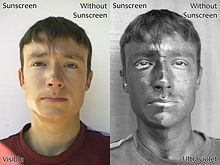
Because UVA does not cause reddening of the skin (erythema), it is not measured in the usual types of SPF testing. There is no good clinical measurement for blockage of UVA radiation, but it is important for sunscreen to block both UVA and UVB. Some scientists blame the absence of UVA filters in sunscreens for the higher melanoma risk found for sunscreen users.
Ultraviolet photons harm the DNA molecules of
living organisms in different ways. In one common damage
event, adjacent 
thymine bases bond with each other, nstead of
across the "ladder". This "
thymine dimer" makes a bulge,
and the distorted DNA molecule does not function properly.
UVB light can cause direct DNA damage. As noted above UVB radiation excites DNA molecules in skin cells, causing aberrant covalent bonds to form between adjacent cytosine bases, producing a dimer. When DNA polymerase comes along to replicate this strand of DNA, it reads the dimer as "AA" and not the original "CC". This causes the DNA replication mechanism to add a "TT" on the growing strand. This mutation can result in cancerous growths, and is known as a "classical C-T mutation". The mutations caused by the direct DNA damage carry a UV signature mutation that is commonly seen in skin cancers. The mutagenicity of UV radiation can be easily observed in bacterial cultures. This cancer connection is one reason for concern about ozone depletion and the ozone hole.

Sunday, March 25, 2012

Infrared Radiations


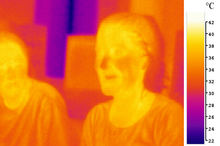
Infrared (IR) light is electromagnetic radiation with a wavelength longer than that of visible light, measured from the nominal edge of visible red light at 0.74 micrometres (µm), and extending conventionally to 300 µm. These wavelengths correspond to a frequency range of approximately 1 to 400 THz, and include most of the thermal radiation emitted by objects near room temperature. Microscopically, IR light is typically emitted or absorbed by molecules when they change the irrotational-vibrational movements.
Infrared light is used in industrial, scientific, and medical applications. Night-vision devices using infrared illumination allow people or animals to be observed without the observer being detected. In astronomy, imaging at infrared wavelengths allows observation of objects obscured by interstellar dust. Infrared imaging cameras are used to detect heat loss in insulated systems, observe changing blood flow in the skin, and overheating of electrical apparatus.
Much of the energy from the Sun arrives on Earth in the form of infrared radiation. Sunlight at zenith provides an irradiance of just over 1 kilowatt per square meter at sea level. Of this energy, 527 watts is infrared radiation, 445 watts is visible light, and 32 watts is ultraviolet radiation. The balance between absorbed and emitted infrared radiation has a critical effect on the Earth's climate.

Main Applications: 


  1. Night Vision: Infrared is used in night vision equipment when there is insufficient visible light to see. Night vision devices operate through a process involving the conversion of ambient light photons into electrons which are then amplified by a chemical and electrical process and then converted back into visible light. Infrared light sources can be used to augment the available ambient light for conversion by night vision devices, increasing in-the-dark visibility without actually using a visible light source. The use of infrared light and night vision devices should not be confused with thermal imaging which creates images based on differences in surface temperature by detecting infrared radiation (heat) that emanates from objects and their surrounding environment.
  2. Hyperspectral Imaging:     
    A hyperspectral image, a basis for chemical imaging, is a "picture" containing continuous spectrum through a wide spectral range. Hyperspectral imaging is gaining importance in the applied spectroscopy particularly in the fields of NIR, SWIR, MWIR, and LWIR spectral regions. Typical applications include biological, mineralogical, defence, and industrial   measurements.Thermal Infrared Hyperspectral Camera can be applied similarly to a Thermographic camera, with the fundamental difference that each pixel contains a full LWIR spectrum. Consequently, chemical identification of the object can be performed without a need for an external light source such as the Sun or the Moon. Such cameras are typically applied for geological measurements, outdoor surveillance and UAV applications 
  3. Heating: Infrared radiation can be used as a deliberate heating source. For example it is used in infrared saunas to heat the occupants, and also to remove ice from the wings of aircraft (de-icing). FIR is also gaining popularity as a safe heat therapy method of natural health care & physiotherapy. Infrared can be used in cooking and heating food as it predominantly heats the opaque, absorbent objects, rather than the air around them. Infrared heating is also becoming more popular in industrial manufacturing processes, e.g. curing of coatings, forming of plastics, annealing, plastic welding, print drying. In these applications, infrared heaters replace convection ovens and contact heating. Efficiency is achieved by matching the wavelength of the infrared heater to the absorption characteristics of the material.


Friday, March 23, 2012

Rainbow


When Sunlight falls on small water droplets suspended in air during or after a rain, it suffers refraction, Total Internal Reflection(TIR) and dispersion. If an observer has the Sun at the back and water droplets in front of himself, then the person may see two rainbows one inside the other. The inner one is called primary rainbow and the outer one is called the secondary rainbow.

A ray of light when passing from air to water suffers refraction, TIR and again refraction. Dispersion takes place at both refractions. It turns out that rays of a given colour are strongly returned by a droplet in a direction tat corresponds to maximum deviation in its path. For red light, the max deviation is 137.8°. So the light comes out of the droplet at an angle of 180°-137.8°= 42.2°. This angle for violet is 40.6°.
The order of colours is Violet, Indigo, Blue, Green, Yellow, Orange & Red inside out. This is the primary rainbow.

The secondary rainbow is formed by rays which suffer two TIRs before coming out of the drop. Therefore, the order of colours in reversed.


Multiple rainbows:

Although most people will not notice it because they are not actively looking for it, a dim secondary rainbow is often present outside the primary bow. Secondary rainbows are caused by a double reflection of sunlight inside the raindrops, and appear at an angle of 50–53°. As a result of the second reflection, the colours of a secondary rainbow are inverted compared to the primary bow, with blue on the outside and red on the inside. The secondary rainbow is fainter than the primary because more light escapes from two reflections compared to one and because the rainbow itself is spread over a greater area of the sky. The dark area of unlit sky lying between the primary and secondary bows is called Alexander's band, afterAlexander of Aphrodisias who first described it.
Very dim tertiary (triple) and even quaternary (quadruple) rainbows have been photographed. These are caused by triple or quadruple reflections of sunlight inside the raindrops. Such rainbows appear on the same side of the sky as the sun, at about 40° from the sun for tertiary and 45° from the sun for quaternary rainbows. It is difficult to see these types of rainbows with the naked eye because of the sun's glare.
Higher-order rainbows were described by Felix Billet (1808–1882) who depicted angular positions up to the 19th-order rainbow, a pattern he called a "rose of rainbows". In the laboratory, it is possible to observe higher-order rainbows by using extremely bright and well collimated light produced by lasers. Up to the 200th-order rainbow was reported by Ng et al. in 1998 using a similar method but an argon ion laser beam.[

Supernumerary rainbow:

A supernumerary rainbow—also known as a stacker rainbow—is an infrequent phenomenon, consisting of several faint rainbows on the inner side of the primary rainbow, and very rarely also outside the secondary rainbow. Supernumerary rainbows are slightly detached and have pastel colour bands that do not fit the usual pattern.
It is not possible to explain their existence using classical geometric optics. The alternating faint rainbows are caused by interference between rays of light following slightly different paths with slightly varying lengths within the raindrops. Some rays are in phase, reinforcing each other through constructive interference, creating a bright band; others are out of phase by up to half a wavelength, cancelling each other out through destructive interference, and creating a gap. Given the different angles of refraction for rays of different colours, the patterns of interference are slightly different for rays of different colours, so each bright band is differentiated in colour, creating a miniature rainbow. Supernumerary rainbows are clearest when raindrops are small and of similar size. The very existence of supernumerary rainbows was historically a first indication of the wave nature of light, and the first explanation was provided by Thomas Young in 1804.

Tertiary and quaternary rainbows

In addition to the primary and secondary rainbows seen in a direction opposite to the sun, it is also possible (but very rare) to see two faint rainbows in the direction of the sun. These are the tertiary and quaternary rainbows, formed by light that has reflected three and four times within the rain drops, respectively. Photographic evidence for the tertiary and quaternary rainbows was published, apparently for the first time, in 2011.

Reflected rainbow, reflection rainbow:

When a rainbow appears above a body of water, two complementary mirror bows may be seen below and above the horizon, originating from different light paths. Their names are slightly different. A reflected rainbow will appear as a mirror image in the water surface below the horizon, if the surface is quiet (see photo above). The sunlight is first deflected by the raindrops, and then reflected off the body of water, before reaching the observer. The reflected rainbow is frequently visible, at least partially, even in small puddles.
Where sunlight reflects off a body of water before reaching the raindrops, it may produce areflection rainbow (see photo at the right), if the water body is large, quiet over its entire surface, and close to the rain curtain. The reflection rainbow appears above the horizon. It intersects the normal rainbow at the horizon, and its arc reaches higher in the sky, with its centre as high above the horizon as the normal rainbow's centre is below it. Due to the combination of requirements, a reflection rainbow is rarely visible.
Six (or even eight) bows may be distinguished if the reflection of the reflection bow, and the secondary bow with its reflections happen to appear simultaneously.

Monochrome rainbow:

An unenhanced photo of a red (monochrome) rainbow.
Occasionally a shower may happen at sunrise or sunset, where the shorter wavelengths like blue and green have been scattered and essentially removed from the spectrum. Further scattering may occur due to the rain, and the result can be the rare and dramatic monochrome rainbow.
Rainbows under moonlight (Moonbows) are often perceived as white and may be thought of as monochrome. The full spectrum is present but our eyes are not normally sensitive enough to see the colours. So these are also classified (on the basis of how we see them) into seven coloured rainbow, three coloured rainbow and monochrome rainbow. Long exposure photographs will sometimes show the colour in this type of rainbow.

Circumhorizontal arc

The circumhorizontal arc is sometimes referred to by the misnomer "fire rainbow". As it originates in ice crystals, it is not a rainbow but a halo.

Rainbows on Titan

It has been suggested that rainbows might exist on Saturn's moon Titan, as it has a wet surface and humid clouds. The radius of a Titan rainbow would be about 49° instead of 42°, because the fluid in that cold environment is methane instead of water. A visitor might need infrared goggles to see the rainbow, as Titan's atmosphere is more transparent for those wavelengths.