Days in the Sun

From solstice to solstice, this six month long exposure compresses time from the 21st of June till the 21st of December, 2011, into a single point of view.

Wolf Moon

A full moon looking yellowish-orange, which the ancients and old people dubbed as wolf moon, accompanied by many mythical stories.

A Star Factory

These are the places in the Milky Way galaxy where stars are formed. Awesome, isn't it?

The Ghost Nebula

The Ghost Nebula, after being captured by the Hubble space telescope

Saturn's Iapetus Moon

This is Saturn's Iapetus moon, which looks painted and colorful, setting it apart from the other moons.

Tuesday, April 26, 2011

Consequences of revolution of the Moon


There are two main consequences of the revolution of the Moon. The Moon revolves around the Earth is an elliptical path. Thus it is near(perigee) and far(apogee) from the Earth in every month. Due to this, there are two effects

  1. Tides
  2. Eclipses
TidesTides are the rise and fall of sea levels caused by the combined effects of the gravitational forces exerted by the Moon and the Sun and the rotation of the Earth.

Most places in the ocean usually experience two high tides and two low tides each day (semidiurnal tide), but some locations experience only one high and one low tide each day (diurnal tide). The times and amplitude of the tides at the coast are influenced by the alignment of the Sun and Moon, by the pattern of tides in the deep ocean  and by the shape of the coastline and near-shore bathymetry
Tides vary on timescales ranging from hours to years due to numerous influences. To make accurate records, tide gauges at fixed stations measure the water level over time. Gauges ignore variations caused by waves with periods shorter than minutes. These data are compared to the reference (or datum) level usually called mean sea level.


While tides are usually the largest source of short-term sea-level fluctuations, sea levels are also subject to forces such as wind and barometric pressure changes, resulting in storm surges, especially in shallow seas and near coasts.
Tidal phenomena are not limited to the oceans, but can occur in other systems whenever a gravitational field that varies in time and space is present. For example, the solid part of the Earth is affected by tides.

Tide changes proceed via the following stages:
  • Sea level rises over several hours, covering the intertidal zone; flood tide.
  • The water rises to its highest level, reaching high tide.
  • Sea level falls over several hours, revealing the intertidal zone; ebb tide.
  • The water stops falling, reaching low tide.
Tides produce oscillating currents known as tidal streams. The moment that the tidal current ceases is called slack water or slack tide. The tide then reverses direction and is said to be turning. Slack water usually occurs near high water and low water. But there are locations where the moments of slack tide differ significantly from those of high and low water.
Tides are most commonly semi-diurnal (two high waters and two low waters each day), or diurnal (one tidal cycle per day). The two high waters on a given day are typically not the same height (the daily inequality); these are the higher high waterand the lower high water in tide tables. Similarly, the two low waters each day are the higher low water and the lower low water. The daily inequality is not consistent and is generally small when the Moon is over the equator.
Eclipses: There are three types of eclipses


  1. Solar Eclipse: The Solar Eclipse is caused by the movement of the Moon. The Moon, while revolving around the Earth, comes in between the Earth and the Sun and the light rays from the Sun are blocked by the Moon, which casts a shadow on the Earth. This is known as the Solar eclipse. But there are two types in Solar Eclipses


              1) Total Solar Eclipse: This is caused in the Umbra region of the shadow
              2) Partial Solar Eclipse: This is caused in the penumbra region of the shadow

  2. Lunar Eclipse:   A lunar eclipse is when the Earth comes between the Sun and the Moon causing a shadow of Earth on the Moon. The shadow can partially or totally cover the Moon, giving us partial and total eclipses.
    Unlike solar eclipses, lunar eclipses are obviously safe to observe without protective gear for the eyes. You may notice that the moon looks spectacularly bright just before and after the eclipse. The Moon's surface is rather reflective, and close to the time of a lunar eclipse you are seeing the most direct reflection possible from the Moon's surface. If it is a very clear night, you will get a beautiful view of the moon. You will see various phases of illumination similar to those observed over the course of a lunar cycle.
    A lunar eclipse occurs when the full Moon lines up precisely with the Earth and the Sun, and the Earth's shadow falls on the Moon. Greek astronomers had figured that out over 2000 years ago, and knew that the curved shadow on the Moon indicated that the Earth was a sphere.


    The most recent total lunar eclipse was on December 21, 2010,
    seen here from California near greatest eclipse.


  3. Annular Solar Eclipse: Annular Solar Eclipse is caused when the Moon is exactly between the Sun and the Earth in such a way that the light rays converge to become an antumbra region from where the Sun looks like a ring when seen from the Earth. This is the Annular Solar Eclipse.


Tuesday, April 19, 2011

Moon

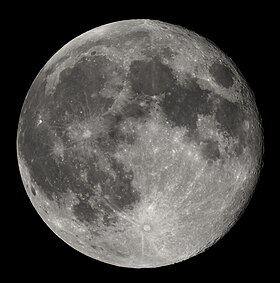
The Moon is the Earth's natural satellite, orbiting around it every 27 days. It is also the fifth largest satellite in the Solar System. The Moon is only a quarter of the size of the Earth or it may be said that it is slightly bigger than the U.S.A. Its mass is 1/81 times of the Earth's. The moon is a cold, dry orb whose surface is studded with craters and strewn with rocks and dust (called regolith). The moon has no atmosphere. Recent lunar missions indicate that there might be some frozen ice at the poles. 

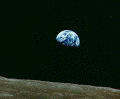
If you were standing on the moon, the sky would always appear dark, even during the daytime. Also, from any spot on the moon (except on the far side of the moon where you cannot see the Earth), the Earth would always be in the same place in the sky; the phase of the Earth changes and the Earth rotates, displaying various continents.

The  Origin Of the Moon
Most scientists believe that the moon was formed from the ejected material after the Earth collided with a Mars-sized object. This ejected material coalesced into the moon that went into orbit around th Earth. This catastrophic collision occurred about 60 million years after Earth itself formed (about 4.3 billion years ago). This is determined by the radioisotope dating of moon rocks 

The prevailing hypothesis today is that the Earth–Moon system formed as a result of a giant impact: a Mars-sized body hit the nearly formed proto-Earth, blasting material into orbit around the proto-Earth, which accreted to form the Moon. Giant impacts are thought to have been common in the early Solar System. Computer simulations modelling a giant impact are consistent with measurements of the angular momentum of the Earth–Moon system, and the small size of the lunar core; they also show that most of the Moon came from the impactor, not from the proto-Earth. However, meteorites show that other inner Solar System bodies such as Mars and Vesta have very different oxygen and tungsten isotopic compositions to the Earth, while the Earth and Moon have near-identical isotopic compositions. Post-impact mixing of the vaporized material between the forming Earth and Moon could have equalized their isotopic compositions, although this is debated.

Characteristics: 
  1. Rotational Period: 29 days 12 hours 44 mins 2.9 seconds
  2. Revolution Period: 27 days 7 hours 43 mins 6.2 seconds
  3. Speed: 1.022 km/s
  4. Radius: 1737.103 km
  5. Equatorial Radius: 1738.142 km                                                              
  6. Polar Radius: 1735.974 km
  7. Surface Area: 3.793 × 107 km2
  8. Escape Velocity: 2.38 km/s
  9. Volume: 2.1958 × 1010 km3 
  10. Mass: 7.3477 × 1022 kg 
  11. Acceleration due to gravity(g): 1.6300545 m/s2 
The Moons Orbit:
The moon is about 238,900 miles (384,000 km) from Earth on average. At its closest approach (the lunar perigee) the moon is 221,460 miles (356,410 km) from the Earth. At its farthest approach (its apogee) the moon is 252,700 miles (406,700 km) from the Earth.

The moon revolves around the Earth in about one month (27 days 8 hours). It rotates around its own axis in the same amount of time. The same side of the moon always faces the Earth; it is in a synchronous rotation with the Earth. 

The Moon's orbit is expanding over time as it slows down (the Earth is also slowing down as it loses energy). For example, a billion years ago, the Moon was much closer to the Earth (roughly 200,000 kilometers) and took only 20 days to orbit the Earth. Also, one Earth 'day' was about 18 hours long (instead of our 24 hour day). The tides on Earth were also much stronger since the moon was closer to the Earth. 

Saros
The saros is the roughly 18-year periodic cycle of the Earth-Moon-Sun system. Every 6,585 days, the Earth, Moon and Sun are in exactly the same position. When there is a lunar eclipse, there will also be one exactly 6,585 days later. 


Mass and Gravity
The moon's mass is (7.35 x 10 22 kg), about 1/81 of the Earth's mass.

The moon's gravitational force is only 17% of the Earth's gravity. For example, a 100 pound (45 kg) person would weigh only 17 pounds (7.6 kg) on the Moon.

The moon's density is 3340 kg/m 3. This is about 3/5 the density of the Earth. 

Temperature
The temperature on the Moon ranges from daytime highs of about 130°C = 265°F to nighttime lows of about -110°C = -170°F 

Atmosphere
The moon has no atmosphere. On the moon, the sky is always appears dark, even on the bright side (because there is no atmosphere). Also, since sound waves travel through air, the moon is silent; there can be no sound transmission on the moon. 

Craters and Rillers  


The surface of the moon is scarred by millions of (mostly circular) impact craters, caused by asteroids, comets, and meteorites. There is no atmosphere on the moon to help protect it from bombardment from potential impactors (most objects from space burn up in our atmosphere). Also, there is no erosion (wind or precipitation) and little geologic activity to wear away these craters, so they remain unchanged until another new impact changes it.

These craters range in size up to many hundreds of kilometers, but the most enormous craters have been flooded by lava, and only parts of the outline are visible. The low elevation maria (seas) have fewer craters than other areas. This is because these areas formed more recently, and have had less time to be hit. The biggest intact lunar crater is Clavius which is 100 miles (160 km) in diameter. 

A rille is a long, narrow valley on the surface of the moon. Hadley Rille is a long valley on the surface of the moon. This rille is 75 miles (125 km) long, 1300 feet (400 m) deep, and almost 1 mile (1500 m) wide at its widest point. It was formed by molten basaltic lava that carved out a steep channel along the base of the Apennine Front (which was explored by the Apollo 15 astronauts in 1971). 

Moon or Double Planet?
The Earth and the Moon are relatively close in size (4:1 in diameter, 81:1 in mass), unlike most planet/moon systems. Many people consider the Earth and Moon to be a double planet system (rather than a planet/moon system). The moon does not actually revolve around the Earth; it revolves around the Sun in concert with the Earth (like a double planet system). 

Libration
Libration is a rocking movement of the Moon. Librations cause us to view the Moon from different angles at different times, enabling us to see about 59 percent of the Moon's surface from Earth, even though the same side always faces us. There are librations due to variations in the rate of the Moon's orbital motion (longitudinal libration) and to the inclination of the Moon's equator with respect to its orbital plane (latitudinal libration). There is also an apparent libration due to an observer on Earth viewing the Moon from different angles as the Earth rotates (diurnal libration, which occurs each day)
.


Two Lunar Months
The sidereal and synodic lunar months have different lengths. The sidereal month is the amount of time it takes the Moon to return to the same position in the sky with respect to the stars; the sidereal month is 27.321 days long. The synodic month is the time between similar lunar phases (e.g., between two full moons); the synodic month is 29.530 days long


Moons Rocks
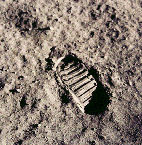
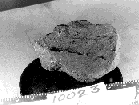
NASA astronauts have retrieved 842 pounds (382 kg) of moon rocks (in many missions), which have been closely studied. The composition of the moon rocks is very similar to that of Earth rocks. Using radioisotope dating, it has been found that moon rocks are about 4.3 billion years old. 

Monday, April 11, 2011

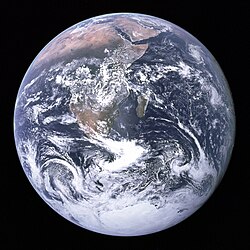
Earth

  The Earth is the third planet from the Sun, in our Solar System. Its is the only planet where life is known. Its third among the terrestrial planets and also the biggest. Its referred to as the World. Up, form above the atmosphere, the Earth looks blue in colour. Its because of the large amounts of water in it. The Earth, though a rocky planet, is mostly filled with water, i.e 70%(approx.) and the land cover only about 30% of the area of Earth.

  The Earth is said to have formed 4.5 billion years ago due to the condensation of the Molecular cloud which also led to the formation of the our Solar System including the Sun. Earth has more than a 1000 species of living beings and so much more have to be discovered. Earth's biosphere has significantly altered the atmosphere and other abiotic conditions on the planet, enabling the proliferation of aerobic organisms as well as the formation of the ozone layer which, together with Earth's magnetic field, blocks harmful solar radiation, permitting life on land. The physical properties of the Earth, as well as its geological history and orbit, have allowed life to persist during this period. The planet is expected to continue supporting life for at least another 500 million years.


Characteristics: 

  1. Rotational period: 23 hours 56 minutes 9 seconds
  2. Revolution period: 365 days 6 hours.
  3. Aphelion: 15,20,98,232 km
  4. Perihelion: 14,70,98,290 km
  5. Speed: 29.78 m/s(1,07, 200 km/h)
  6. Radius: 6371 km
  7. Polar radius: 635.8 km
  8. Equatorial radius: 6378.1 km
  9. Surface Area: 510,072,000 km2
  10. Escape Velocity: 11.186 km/s
  11. Volume: 1.08321×10¹² km3
  12. Mass: 5.9736×1024 kg
  13. Acceleration due to gravity(g): 9.780327 m/s2
  • Surface pressure : 101.325 kPa (MSL or Mean Sea Level)
  • Composition : 
    •       78.08% nitrogen (N2)       
    •       20.95% oxygen (O2)
    •       0.93% argon
    •       0.038% carbon dioxide               
    •       About 1% water vapor (varies with climate)
                               

Geology: Earth's outer surface is divided into several rigid segments, or tectonic plates, that migrate across the surface over periods of many millions of years. About 71% of the surface is covered with salt water oceans, the remainder consisting of continents and islands which together have many lakes and other sources of water contributing to the hydrosphere. Liquid water, necessary for all known life, is not known to exist in equilibrium on any other planet's surface. Earth's poles are mostly covered with solid ice (Antarctic ice sheet) or sea ice (Arctic ice cap). The planet's interior remains active, with a thick layer of relatively solid mantle, a liquid outer core that generates a magnetic field, and a solid iron inner core.

Internal Structure: The interior of the Earth, like that of the other terrestrial planets, is divided into layers by their chemical or physical (rheological) properties, but unlike the other terrestrial planets, its core is distinct. The outer layer of the Earth is a chemically distinct silicate solid crust or sand which is mainly made up of silica, which is underlain by a highly viscous solid mantle. The crust is separated from the mantle by the Mohorovicic discontinuity(Mohorovicic - an Arabian scientist who found a discontinuity between the two layers), and the thickness of the crust varies: averaging 6 km under the oceans and 30–50 km on the continents. The temperature rises with an average of 1°C per kilometer.


Layers of the Earth


 The crust and the cold, rigid, top of the upper mantle are collectively known as the lithosphere, and it is of the lithosphere that the tectonic plates are comprised. Beneath the lithosphere is the asthenosphere, a relatively low-viscosity layer on which the lithosphere rides. Important changes in crystal structure within the mantle occur at 410 and 660 kilometers below the surface, spanning a transition zone that separates the upper and lower mantle. Beneath the mantle, an extremely low viscosity liquid outer core lies above a solid inner core. The inner core may rotate at a slightly higher angular velocity than the remainder of the planet, advancing by 0.1–0.5° per year.


Crust: The outer most layer, the crust, is categorized into two parts, the Oceanic crust and the continental crust. The Oceanic crust is the smallest part of Earth, only 0.099% of its mass and reaching a small depth of 0-6 miles (0-10 kilometers). In the beginning of time, it was possible that this area did not exist for through frequent volcanic activity does only the crust form. Evidence of this is marked by the oceanic ridge system, which is a 25,000 mile (40,000-kilometer) array of many volcanoes which creates layer after layer of new crust at the rate of 17 km3 per year. The ocean floor is covered in basalt originating from volcanic activity and as a matter of fact, Iceland and Hawaii are two island systems that emerged from the accumulated basalt


Continental crust: The second smallest area of the Earth is the Continental crust, making up only 0.374% of the Earth's mass and extending a short depth of 0 - 31 miles (0-50 kilometers). Looking at the percent by composition, the continental crust makes up only 0.554% of the mantle-crust mass. The layer is composed primarily of crystalline rocks made of low-density buoyant minerals dominated mostly by quartz (SiO2) and feldspars (metal-poor silicates). This is the outer part of the Earth composed essentially of crystalline rocks. The continental crust and the oceanic crust are also referred to as the lithosphere because of the cool and rocky conditions that exist in its chemical composition.
Crust


The next layer, the Transition region comprises 7.5% of Earth's mass with a depth of 250-406 miles (400-650 kilometers). This layer is also known as the mesosphere and is 11.1% of the mantle-crust. It is made of mainly basaltic magmas with amounts of calcium, aluminum and garnet (an aluminum-bearing silicate mineral). The layer becomes dense when the garnet mineral cools but is buoyant and light when subject to heat due to the low melting points


The D" layer of Earth is about 3% of Earth's mass, is 125 to 188 miles (200 to 300 kilometers) thick and covers about 4% of the mantle-crust mass. This layer, in terms of whether it is part of the lower mantle or an independent layer is still somewhat unclear. Based on evidence collected from seismic discontinuities, the D" layer might differ in chemical composition from the lower mantle above it.


Mantle: Lower down, we encounter the upper mantle. Through excavations in volcanoes, scientists have found that this part of the crust composes of 15.3% of the total mantle-crust mass and is made of crystalline forms of Olivine (Mg,Fe)2SiO4 and pyroxene (Mg,Fe)SiO3. The upper mantle makes up 10.3% of the Earth's mass, extending a depth of 6-250 miles (10-400 kilometers). A relatively large portion when compared to the other interior layers. This layer is not completely made of solid minerals for scientists speculate that the asthenosphere could be partly liquid molten.

Looking at the lower mantle, its chemical omposition includes silicon, magnesium, and oxygen. Most likely, it probably also contains some iron, calcium, and aluminum. This layer is comprised of 72.9% of the antle-crust mass, making the Earth abundant in the chemical elements of silicon, magnesium and oxygen, the layer's primary components.


Mantle

Core: The outer core is in the range of 200 to 300 kilometers (125 to 188 miles) thick and represents about 4% of the mantle-crust mass. This layer is sometimes identified as part of the lower mantle due to its geographical nature. However, studies on seismic discontinuities suggest that this "D" layer might differ chemically rom the lower mantle lying above it.


Tuesday, April 5, 2011

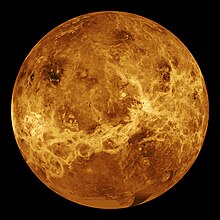
Venus

Venus

Venus is the second planet from the Sun. It is a fiery, hot planet which has mostly Carbon Dioxide. The size of the planet is nearly equal to that of Earth's, so its called as Earth's twin though its physically different from Earth except that it is rocky. Venus, since is covered by a Carbon Dioxide atmosphere, forms a thick cloud or a blanket over its surface and this atmosphere actually reflects 75%(approx.) of the sun light. Thus this planet is also called as the morning star and the evening star since it can be seen at dawn and at dusk. Early astronomers thought Venus was actually a star.
 The planet looks extremely beautiful in the night sky and so has been named 'Venus' after the Roman Goddess of beauty and love.
 Venus is a special planet. Its day is more than its year, i.e it takes lesser time to revolve around the Sun than rotate on its own axis.

  1. Rotational period(day): 243 Earth days.
  2. Revolution period(year): 224..7(225) Earth days.
  3. Aphelion: 108,942,109 km
  4. Perihelion: 107,476,259 km
  5. Speed: 35.019 km/s
  6. Radius: 6,051.8 ± 1.0 km
  7. Surface Area: 4.60×10⁸ km2
  8. Escape Velocity: 10.46 km/s
  9. Volume: 9.38 X 1011 km3 
  10. Mass: 4.868 5×1024 kg
  11. Acceleration due to gravity(g): 8.87 m/s2
Geology: There has been no information of its moment of inertia, so there is little direct information about the internal structure and geochemistry of Venus. However, the similarity in size and density between Venus and Earth suggests that they share a similar internal structure: a core, mantle, and crust. Like that of Earth, the Venusian core is at least partially liquid because the two planets have been cooling at about the same rate. The slightly smaller size of Venus suggests that pressures are significantly lower in its deep interior than Earth. The principal difference between the two planets is the lack of plate tectonics on Venus, likely due to the dry surface and mantle. This results in reduced heat loss from the planet, preventing it from cooling and providing a likely explanation for its lack of an internally generated magnetic field

AtmosphereVenus has an extremely dense atmosphere, which consists mainly of carbon dioxide and a small amount of nitrogen. The atmospheric mass is 93 times that of Earth's atmosphere while the pressure at the planet's surface is about 92 times that at Earth's surface—a pressure equivalent to that at a depth of nearly 1 kilometer under Earth's oceans. The density at the surface is 65 kg/m³ (6.5% that of water). The CO2-rich atmosphere, along with thick clouds of Sulphur dioxide, generates the strongest greenhouse effect in the Solar System, creating surface temperatures of over 460 °C (860 °F). This makes the Venusian surface hotter than Mercury's which has a minimum surface temperature of −220 °C and maximum surface temperature of 420 °C, even though Venus is nearly twice Mercury's distance from the Sun and thus receives only 25% of Mercury's solarirradiance.


The first robotic space probe mission to Venus, and the first to any planet, began on February 12, 1961 with the launch of the Venera 1 probe. The first craft of the otherwise highly successful SovietVenera program, Venera 1 was launched on a direct impact trajectory, but contact was lost seven days into the mission, when the probe was about 2 million km from Earth.


Tuesday, March 29, 2011

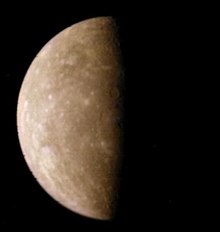
Mercury

Mercury is nearest planet to the Sun. Its also the smallest planet in the Solar System. The degree of axis of tilt of Mercury is just 2. It is so close to the Sun that it is difficult to see it from the ground. This explains why some early astronomers never saw the planet. When seen from the Earth Mercury is never far from the Sun in the sky. Because of the glare of the Sun, it can only be seen in twilight or in the dawn. That is why it is called as the morning or evening star.


 Mercury was first recorded by Timocharis in 265 BC. Other early astronomers who studied Mercury include Zupus(1639 BC) who studied its orbit. The perihelion of Mercury's orbit precesses around the Sun at an excess of 43 arcseconds per century; a phenomenon that was explained in the 20th century by Albert Einstein's General Theory of Relativity. Mercury is bright when viewed from Earth, ranging from −2.3 to 5.7 in apparent magnitude, but is not easily seen as its greatest angular separation from the Sun is only 28.3°. Since Mercury is normally lost in the glare of the Sun, unless there is a solar eclipse it can be viewed from Earth's Northern Hemisphere only in morning or evening twilight, while its extreme elongations occur in Declinations south of the celestial equator, such that it can be seen at favorable apparitions from moderate latitudes in the Southern Hemisphere in a fully dark sky. 


  1. Distance from sun: 58 million miles
    aphelion - 70 million miles
    perihelion - 48 million miles 
  2. Diameter: 4878 km
  3. Year: 88 Earth days
  4. Day: 59 Earth days
  5. Moons: 0
  6. Crust: 300 km
  7. Mantle: 700 km
  8. Core: <1800 km
  9. Surface Area: 7.483 km2
  10. Volume: 6.083 X 10^10 km
  11. Mass: 3.3021 X 10^23 kg
  12. Mean Density: 5.427 g /cm^3
  13. Escape Velocity: 4.25 km/s
  14. Atmosphere: No
Due to absence of atmosphere, there is a high range of temperature. In the morning, the temperatures soar upto 400 °C but at night, the temperatures drop to about -200 °C


Friday, March 25, 2011

Planets and methods of finding them

 
   A Planet is a celestial body which revolves around stars. For example, Earth, Venus, Jupiter etc.. The word 'planets' is derived from Greek meaning 'wanderers or wandering stars' since planet looked like stars and also seemed to move or revolve. Planets were all discovered approximately between 1900- 1400 BC, but no one actually made many observations except for predicting them.
   The planets are bound by the gravitation or the force of gravity of the stars they revolve around. The concept of force of gravity was first proposed by Sir Isaac Newton. But the planets follow the Kepler's law of planetary motion.


  The planets were thought by Ptolemy to orbit the Earth in deferent and epicycle motions. Though the idea that the planets orbited the Sun had been suggested many times, it was not until the 17th century that this view was supported by evidence from the first telescopic astronomical observations, performed by Galileo Galilei. By careful analysis of the observation data, Johannes Kepler found the planets' orbits to be not circular, but elliptical though this experimentation was done in and about 450-500 AD by Aryabhatta. As observational tools improved,astronomers saw that, like Earth, the planets rotated around tilted axes, and some shared such features as ice-caps and seasons. Since the dawn of the Space Age, close observation by probes has found that Earth and the other planets share characteristics such as volcanism, hurricanes, tectonics, and even hydrology.
Geocentricism
The five classical planets, being visible to the naked eye, have been known since ancient times, and have had a significant impact on mythology, religious cosmology, and ancient astronomy. In ancient times, astronomers noted how certain lights moved across the sky in relation to the other stars. Ancient Greeks called these lights wandering stars or simply  wanderers, from which today's word "planet" was derived. In ancient Greece, China, Babylon and indeed all pre-modern civilisations, it was almost universally believed that Earth was in the center of the Universe and that all the "planets" circled the Earth. This is know as geocentricism. The reasons for this perception were that stars and planets appeared to revolve around the Earth each day, and the apparently common-sense perception that the Earth was solid and stable, and that it was not moving but at rest.
  With the advancement of technology, the planets of the Solar System were discovered and later Pluto was even made a dwarf planet in the year 2006. 
Search for extra-solar planet:  The search for any other planet like earth which could support life began in the early 2000s. The concept of another planet in the universe which could support life simply flashed in the mind of scientists since there were billions of trillions of stars in the universe and so there were chances that they might be a planet which supported life. Now the probability of finding a planet with life is 100%  but not on all the planets.


Methods of finding a planet: Till date, astronomers have discovered over 200 planets revolving around the stars. So finding it wasn't very easy.  They used two main methods of doing it


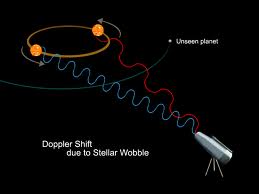
Doppler Shift


Doppler shift due to stellar wobble.
This method has been the most successful.
Precise measurement of the velocity or change of position of stars tells us the extent of the star's movement induced by a planet's gravitational tug. From that information, scientists can deduce the planet's mass and orbit.


Why does a planet cause a star to sway? If a star has a single companion, both move in nearly circular orbits around their common center of mass. Even if one body is much smaller, the laws of physics dictate that both will orbit the center of the combined star and planet system. The center of mass is the point at which the two bodies balance each other.


The radial velocity method measures slight changes in a star's velocity as the star and the planet move about their common center of mass. In this case, however, the motion detected is toward the observer and away from the observer. Astronomers can detect these variances by analyzing the spectrum of starlight. In an effect known as Doppler shift, light waves from a star moving toward us are shifted toward the blue end of the spectrum. If the star is moving away, the light waves shift toward the red end of the spectrum.
This happens because the waves become compressed when the star is approaching the observer and spread out when the star is receding. The effect is similar to the change in pitch we hear in a train's whistle as it approaches and passes.


The larger the planet and the closer it is to the host star, the faster the star moves about the center of mass, causing a larger color shift in the spectrum of starlight. That's why many of the first planets discovered are Jupiter-class (300 times as massive as Earth), with orbits very close to their parent stars.


Astrometric Measurement

  As with the radial velocity technique, this methods depends on the slight motion of the star caused by the orbiting planet. In this case, however, astronomers are searching for the tiny displacements of the stars on the sky.

Astrometric displacement of the Sun due to Jupiter as at it would be observed from 10 parsecs, or about 33 light-years.
The planets of our solar system have this effect on the Sun, producing a to-and-fro motion that could be detected by an observer positioned several light years away.
An important goal of the Space Interferometry Mission is to detect the presence of Earth-size planets orbiting nearby solar type stars via narrow angle astrometry. Similarly, the Keck Interferometry will conduct an astrometric survey of hundreds of stars to search for planets with masses as small as Uranus.


Transit Method


Transit Method.
If a planet passes directly between a star and an observer's line of sight, it blocks out a tiny portion of the star's light, thus reducing its apparent brightness.
Sensitive instruments can detect this periodic dip in brightness. From the period and depth of the transits, the orbit and size of the planetary companions can be calculated. Smaller planets will produce a smaller effect, and vice-versa. A terrestrial planet in an Earth-like orbit, for example, would produce a minute dip in stellar brightness that would last just a few hours.


Gravitational Microlensing


Gravitational Microlensing - Light from a distant star is bent and focused by gravity as a planet passes between the star and Earth.


This method derives from one of the insights of Einstein's theory of general relativity: gravity bends space. We normally think of light as traveling in a straight line, but light rays become bent when passing through space that is warped by the presence of a massive object such as a star. This effect has been proven by observations of the Sun's gravitational effect on starlight.
When a planet happens to pass in front of a host star along our line of sight, the planet's gravity will behave like a lens. This focuses the light rays and causes a temporary sharp increase in brightness and change of the apparent position of the star.
Astronomers can use the gravitational microlensing effect to find objects that emit no light or are otherwise undetectable.