Days in the Sun

From solstice to solstice, this six month long exposure compresses time from the 21st of June till the 21st of December, 2011, into a single point of view.

Wolf Moon

A full moon looking yellowish-orange, which the ancients and old people dubbed as wolf moon, accompanied by many mythical stories.

A Star Factory

These are the places in the Milky Way galaxy where stars are formed. Awesome, isn't it?

The Ghost Nebula

The Ghost Nebula, after being captured by the Hubble space telescope

Saturn's Iapetus Moon

This is Saturn's Iapetus moon, which looks painted and colorful, setting it apart from the other moons.

Monday, March 21, 2011

Kepler's laws of planetary motion


From ancient times, humans have observed the movements of the planets, stars, and other celestial objects. In ancient history, these observations led scientists to regard Earth as the center of the Universe because of the movement of the rotation of the earth. This geocentric model was elaborated and formalized by the Greek astronomer Claudius Ptolemy(100 AD  - 170 AD) in the second century and was accepted for another 1400 years.
Ptolemy's law of planetary motion


 In 1543, Polish astronomer Nicolaus Copernicus (1473-1543) suggested that that the Earth and other planets revolved in circular orbits around the Sun(heliocentric theory). But no one believed him. The King was so angry with him that he killed Copernicus by slow poisoning.
Nicolaus Copernicus


German astronomer Johannes Kepler, who was Brahe's assistant for a short while, before his death,spent 16 years trying to deduce a mathematical model for the motion of the planets. Such data were difficult to sort out because the moving planets are observed from the moving Earth. After many laborious calculations, Kepler found that Brahe's data of the revolution of Mars around the Sun, led to a successful model.

Johannes Kepler


Kepler completed his analysis and summarized into three parts known as ''Kepler's laws of planetary motion''.
They are: 


  1.       All planets move in elliptical orbits around the Sun at one Focus.
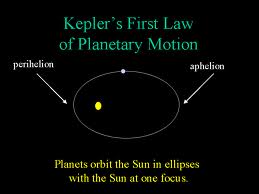

  2.       The radius vector drawn from the Sun to a planet sweeps out equal areas in equal time intervals.

  3. The square of the orbital period of any planet is proportional to the cube of the semi-major axis  of the elliptical orbit.


Saturday, March 19, 2011

Special article: Super Moon

Seriously not the Sun but the Supermoon


A supermoon, in astrology is a full or new moon that coincides with a close approach by the Moon to the Earth. The Moon's distance varies each month between approximately 354,000 km (220,000 mi) and 410,000 km (254,000 mi). This can be said as the Moon's perihelion where it is closest to Earth


Coined By: Richard Nolle in 1979, an astrologer.
'Supermoon' term is not widely accepted by astronomers or scientists or used within the astronomy or scientific community, who prefer the term perigee-syzygy.
Full Moon


Since the Moon will be closest to the Earth during the occurrence of 'Supermoon', there will be effect of gravity on the oceans and seas. The Tides are greatest when the Moon is full or during a New Moon. Thus being nearest, it will increase the height of the tides.


These are the dates of Supermoon occurrences recorded.

  1. November 10, 1954
  2. November 20, 1972
  3. January 8, 1974
  4. February 26, 1975
  5. December 2, 1990
  6. January 19, 1992
  7. March 8, 1993
  8. January 10, 2005
  9. December 12, 2008
  10. January 30, 2010
  11. March 19, 2011
  12. November 14, 2016
  13. January 2, 2018
  14. January 21, 2023
  15. November 25, 2034
  16. January 13, 2036
Relation with disasters: Superstitions make people believe that many devastating disasters are caused because of the 'Supermoon'. But it is a mere co-incidence. On 24th of December, 2004 a Tsunami struck the Indian Ocean and it countries which was caused by a 9.1 magnitude earthquake. 2 weeks later, on January 10th, 2005 a Supermoon occurred.
 A week before, Japan was sunk by a Tsunami, and just a week later, here it is again. And all news channels discussing about the connection between the supermoon and the disasters. But, according to scientific calculations and logic, these two are not inter-linked.

Friday, March 18, 2011

Types of touch screens


  A touchscreen is an electronic visual display that can detect the presence and location of a touch within the display area. The term generally refers to touching the display of the device with a finger or hand.

Touchscreens are common in devices such as all-in-one computers, tablet computers, and smartphones, phones etc.. Now touch can also be seen on TVs, machines like washing machines and even watches.
The touchscreen has two main attributes. First, it enables one to interact directly with what is displayed, rather than indirectly with a cursor controlled by a mouse or touchpad. Secondly, it lets one do so without requiring any intermediate device that would need to be held in the hand. Such displays can be attached to computers, or to networks as terminals. They also play a prominent role in the design of digital appliances such as the personal digital assistant (PDA), satellite navigation devices, mobile phones, and video games.
There are two types of touch screen devices:
1) Resistive Touch:
In electrical engineering, resistive touchscreens are touch-sensitive computer displays composed of two flexible sheets coated with a resistive material and separated by an air gap or microdots. When contact is made to the surface of the touchscreen, the two sheets are pressed together. On these two sheets there are horizontal and vertical lines that when pushed together, register the precise location of the touch. Because the touchscreen senses input from contact with nearly any object (finger, stylus/pen, palm) resistive touchscreens are a type of "passive"
technology.
For example, during operation of a four-wire touchscreen, a uniform, unidirectional voltage gradient is applied to the first sheet. When the two sheets are pressed together, the second sheet measures the voltage as distance along the first sheet, providing the X coordinate. When this contact coordinate has been acquired, the uniform voltage gradient is applied to the second sheet to ascertain the Y coordinate. These operations occur within a few milliseconds, registering the exact touch location as contact is made.
Resistive touchscreens typically have high resolution (4096 x 4096 DPI or higher), providing accurate touch control. Because the touchscreen responds to pressure on its surface, contact can be made with a finger or any other pointing device.
2)Capacitive Touch/ Sensing:
In electrical engineering, capacitive sensing is a technology based on capacitive coupling that is used in many different types of sensors, including those to detect and measure: proximity, position or displacement, humidity, fluid level, and acceleration. Capacitive sensing as a human interface device (HID) technology, for example to replace the computer mouse, is growing increasingly popular. Capacitive touch sensors are used in many devices such as laptop trackpads, digital audio players, computer displays, mobile phones, mobile devices and others. More and more design engineers are selecting capacitive sensors for their versatility, reliability and robustness, unique human-device interface and cost reduction over mechanical switches.
Capacitive sensors detect anything which is conductive or having dielectric properties. While capacitive sensing applications can replace mechanical buttons with capacitive alternatives, other technologies such as multi-touch and gesture-based touchscreens are also premised on capacitive sensing.
Design:
Capacitive sensors can be constructed from many different media, such as copper, Indium tin oxide (ITO) and printed ink. Copper capacitive sensors can be implemented on standard FR4 PCBs as well as on flexible material. ITO allows the capacitive sensor to be up to 90% transparent (for one layer solutions). The size and spacing of the capacitive sensor are both very important to the sensor's performance.

In addition to the size of the sensor, and its spacing relative to the ground plane, the type of ground plane used is very important. Since the parasitic capacitance of the sensor is related to the electric field's (e-field) path to ground, it is important to choose a ground plane that limits the concentration of e-field lines with no conductive object present.
Designing a capacitance sensing system requires first picking the type of sensing material (FR4, Flex, ITO, etc.). One also needs to understand the environment the device will operate in, such as the full operating temperature range, what radio frequencies are present and how the user will interact with the interface.
There are two types of capacitive sensing system: mutual capacitance, where the object (finger, conductive stylus) alters the mutual coupling between row and column electrodes, which are scanned sequentially; and self- or absolute capacitance where the object (such as a finger) loads the sensor or increases the parasitic capacitance to ground. In both cases, the difference of a preceding absolute position from the present absolute position yields the relative motion of the object or finger during that time.

Monday, March 14, 2011

Sunspot, Solar Flare and Solar Wind

Sunspots:Sunspots are said to be the coolest parts of the sun. Indeed, they are. Their temperatures range between 2,727–4,227 °C.  These are actually phenomenons on the photosphere of the sun. They appear black against the background. They are caused by intense magnetic field which are like Eddy currents and thus form reduced surface temperature.  The sunspots move around the sun in a cycle of 11 years called the Sunspot cycle. Every 11 years the sunspots increase and decrease. They appear they most on 6th year and thus large number of sunspots are seen. The are the least every 1st and 11th year. 


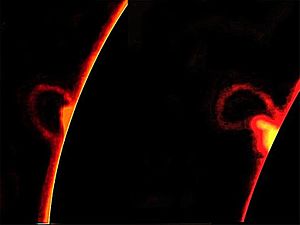
Solar Flares: Solar flares are tremendous explosions on the surface of the Sun. In a matter of just a few minutes they heat material to many millions of degrees and release as much energy as a billion megatons of TNT. They occur near sunspots, usually along the dividing line (neutral line) between areas of oppositely directed magnetic fields. It releases as much as 6 × 1025 joules of energy. 
 The Solar Flares heat up the plasma also to over 10 million Kelvin. These can some times lead to Solar winds or popularly called Coronal Mass Ejections(CME). Flares occur around the sunspots due to intense magnetic fluxes. These Flares are also helped by the magnetic Fields which are stored in the Corona.                                                                


A Solar Flare
Scientific research has shown that the phenomenon of magnetic reconnection is responsible for solar flares. Magnetic reconnection is the name given to the rearrangement of magnetic lines of force when two oppositely directed magnetic fields are brought together. This rearrangement is accompanied with a sudden release of energy stored in the original oppositely directed fields.

  Solar Flares are classified as 

  1. A
  2. B
  3. C
  4. M and
  5. X
Numbers are also suffixed along the letters till '5'. For example C1, C2.....C5. The Sun is a C3 star. The winds released by these flares reach earth within minutes and cause bright spectacles of light. These light spectacles or curtains of light are known by different names in each hemisphere. 

Northern Lights

  1. Northern Hemisphere - Aurora Borealis or Northern light 
  2. Southern Hemisphere - Aurora Australis or Southern light


Solar wind: 
The solar wind is a stream of charged particles ejected from the upper atmosphere of the Sun. It mostly consists of electrons and protons with energies usually between 10 and 100 keV. The stream of particles varies in temperature and speed over time. These particles can escape the Sun's gravity because of their high kinetic energy and the high temperature of the corona.

The solar wind creates the heliosphere, a vast bubble in the interstellar medium that surrounds the solar system. Other phenomena include geomagnetic storms that can knock out power grids on Earth, the aurorae (northern and southern lights), and the plasma tails of comets that always point away from the Sun.
  

Thursday, March 10, 2011

The Sun

The Sun is one of the numerous stars present in our Universe. The Sun is a hot ball of gas and fire. It is the only star visible during the day time. It is a very huge ball of fire. The mean distance of the Sun from the Earth is approximately 149.6 million kilometers (1 AU), though the distance varies as the Earth moves from perihelion in January to aphelion in July. At this average distance, light travels from the Sun to Earth in about 8 minutes and 19 seconds.

The Sun orbits the center of the Milky Way at a distance of approximately 26,000 light yearsThe Sun is formally designated as a Yellow dwarf though from the surface of the Earth it may appear yellow because of atmospheric scattering of blue light.
  1. The Sun is about 1.99 x 1030 Kg in weight and accounts about 98.8556% of the mass of the Solar System. 
  2. The mean radius of the Sun is about 6.96 x 105km 
  3. Its mean density is 1410 Kg/m3
  4. Its acceleration due to gravity at the surface is 274 m/s2
  5. Its surface temperature reaches upto 6000 K and thus is an orange star.
  6. Its rate of emission of total radiation is 3.92 x 1026 Watt
  7. Its escape velocity is 617.723 Km/sec
  8. It takes 37 days at the poles and 26 days at the equator.
  9. It is about 93 million miles! away from the earth(93 million miles = i astronomical unit(AU)).
  10. Its mean distance from the center of the Milky Way galaxy is 26,000 light years.
  11. It orbits the center of the galaxy at a speed of 220 Km/s
  The Sun actually does not have a fixed number of poles. Scientists estimate that the sun has about a 1000 different poles. Therefore it does not rotate as a right body and so its rotational period differs.

Surya

Helios
Sun was once thought of a God. In different mythologies, Sun represented different Gods. In Greek Mythology, Sun was named as Helios. In Indian myths, it was called by different name like Surya, Bhaskara etc..             


  The Sun is mainly composed of Hydrogen and helium but traces of other elements are found in it.
  1. Hydrogen - 73.463%
  2. Helium - 24.851%
  3. Oxygen - 0.769%
  4. Carbon - 0.292%
  5. Iron - 0.157%
  6. Sulphur - 0.124%
  7. Neon - 0.122%
  8. Nitrogen - 0.09%
  9. Silicon - 0.07%
  10. Magnesium - 0.05%
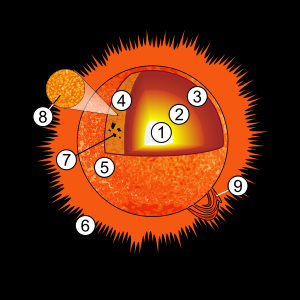
Layers of the Sun(inside to outside):


  1.  Core: The core is the innermost layer of the sun and it is a source for all the Sun's energy. The material in the core is firmly attached and has very high temperature, which is about 15 million degrees Kelvin. In the core the intense heat destroys the internal structure of an atom and therefore all atoms are broken down into their constituent parts. An atom is composed of protons, electrons and neutrons. Neutrons have no electric charge and so they do not interact a lot with the surrounding medium. Thus neutrons go away the core fairly and quickly. The protons, which have positive electric charge, and the electrons, which have negative electric charge, remain in the core and force the reactions which fuel the Sun. The charge neutral material of protons and electrons that makes up the core is called plasma. The high temperature provides the protons and electrons with a great amount of thermal energy and therefore they moved pretty quickly and they combine with the high density of the plasma, causes the particles to continuously slam into one another creating nuclear reactions. It is the fusion, or slamming together, of particular combinations of particles that provides the energy source of the Sun.The core is the innermost layer of the sun and it is a source for all the Sun's energy. Thermonuclear reactions takes place inside the core ,thus hydrogen atoms are comnbined with each other to make helium atoms and produces energy which keeps the Sun in a state of equilibrium.Thus this thermonuclear reaction is called nuclear fusion                                                                                                                                                                                   
  2. Radiation Zone: Once the energy is produced in the core of the sun, it has to travel from the solar center to the outer regions. Hence the radiation zone provides an efficient means of transferring energy near the core. The temperature in the radiation zone of the sun is cooler than the core. The material 0.2 to about 0.7 solar radii is hot and dense enough that thermal radiation is sufficient to transfer the intense heat of the core outward. Heat is transferred by ions of hydrogen and helium emitting photons, which travel a brief distance before being re-absorbed by other ions.
  3. Convection ZoneRanging from 0.7 solar radii to 1.0 solar radii, the material in the Sun is not that much dense or hot to transfer the heat energy from interior to outward. Hence, thermal convection occurs as thermal columns carry hot material to the surface (photosphere) of the Sun. As soon as the material cools off at the surface, it plunges backside downward to the base of the convection zone, to obtain more heat from the top of the radiative zone. Convective exceed is thought to occur at the base of the convection zone, moving turbulent down flows into the outer layers of the radiative zone.The thermal columns in the convection zone shape mark on the surface of the Sun, in the form of the solar granulation and supergranulation. The turbulent convection of this outer part of the solar interior gives rise to a 'small-scale' dynamo that produces magnetic north and south poles all over the surface of the Sun.             
  4. PhotospherePhotosphere is the visible surface of the Sun. Above the photosphere, sunlight is free to disseminate into space and its energy escapes the Sun completely. Sunlight has approximately a black-body spectrum that indicates its temperature is about 6,000 K, interspersed with atomic absorption lines from the tenuous layers above the photosphere. The photosphere has a element density of about 1023/m3 (this is about 1% of the particle density of Earth's atmosphere at sea level). The parts of the Sun above the photosphere are referred to collectively as the solar atmosphere. They can be seen with telescopes across the electromagnetic spectrum, from the visible light to gamma rays.
      The Photosphere
  5. Chromosphere: This a thin layer present above the visible surface, which is about 2,000 km thick, specifically dominated by a spectrum of emission and absorption lines. It is called the chromosphere from the Greek root chromos, meaning color, for the reason that the chromosphere is visible as a colored flash at the beginning and end of total eclipses of the Sun.
  6. The Chromosphere
  7. Corona: The corona is the outer atmosphere of the Sun, which is much larger in volume than the Sun itself. The corona merges slickly with the solar wind so as to fill the solar system and heliosphere. The low corona, which is very close to the surface of the Sun, has a particle density of 1011/m3 (Earth's atmosphere near sea level has a particle density of about 2x1025/m3). The temperature of the corona is several million degrees K. The corona can be clearly seen during a total solar eclipse or during an annular solar eclipse when a ring is seen on the sun.     
      The Annular Solar Eclipse
      The Solar Ring


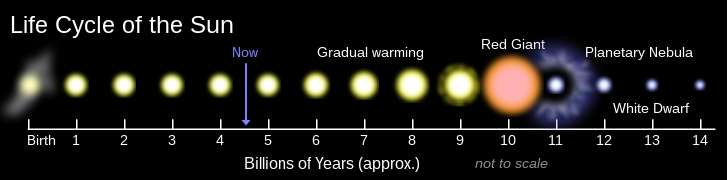
 The Sun was formed 4.57 billion years ago when hydrogen molecular cloud collapsed. The cloud came close by because of the pull of gravity and the cloud of gases started to heat up due to friction. The temperature became so hot that the hydrogen atoms started colliding with each other, Nuclear Fusion started taking place and thus the Sun was formed. 
 The Sun is already half-way through its main sequence of evolution. In another 5 billion years, the sun would have consumed all of the hydrogen present in it and it the main phase of it would start i.e becoming a Red Giant. Since it doesn't have enough mass to turn into a nova or a supernova, the Sun will settle down as a white dwarf but it would have consumed all of the planets in itself including the Earth.
           

  The light which is emitted from the sun is the primary source of life on earth. The Sun emits about 1368Watt/m2 which is known as the Solar constant. The amount of light reaching the earth's surface is only 1000Watt/m2 . The rest is attenuated(absorbed) by the earth's atmosphere. 


Thursday, March 3, 2011

The Solar System

The Solar System
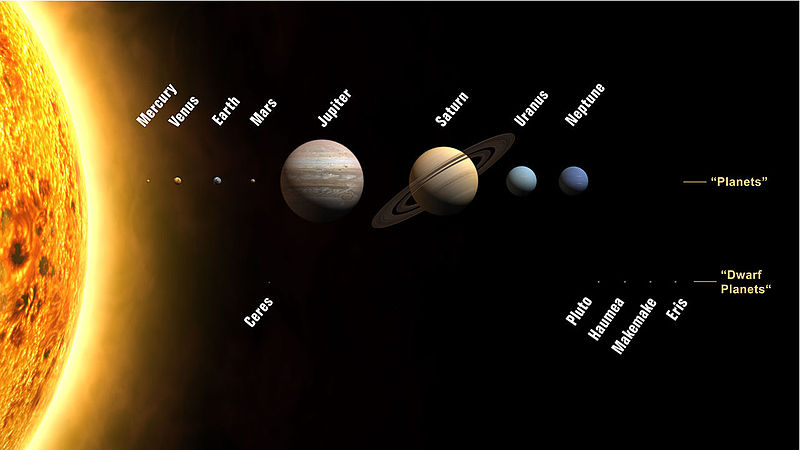
   The Solar System is one of the star systems present in the Universe. The Solar System is believed to have formed about 4.6 billion years ago due to the collapse of the Molecular cloud which also lead tho the formation of the Sun and the constituents planets of the Solar System. All of the things present in the Solar System orbit around the Sun in an elliptical plane or orbital plane. Most of the mass of the Solar System is because of the sun which provides 98.86% of the total mass. The objects orbiting around the Solar System are Planets, Asteroids Meteoroids, Comets etc..

     The Solar System is composed of 8 different planets, formerly 9, the 9th being Pluto, was exterminated as a planet because it could not fulfill the criteria of a planet and was regarded as a Dwarf planet.
     The planets according to their arrangement are like this:
  1. Mercury
  2. Venus
  3. Earth
  4. Mars
  5. Jupiter
  6. Saturn
  7. Uranus
  8. Neptune
 The first four planets, i.e Mercury, Venus, Earth and Mars are called Rocky Planets or Terrestrial Planets because they are mostly made up of rocks. These are also known as Inner Planets.  The next two Jupiter and Saturn are called Gas Giants since they are made up of gases mainly Hydrogen and Helium. The last two Uranus and Neptune are called Ice Planets because they are mainly made up of ice. They are so far away from the Sun that they hardly receive any sunlight and so they are very cold.
Why do the planets orbit around the sun???
  The Sun is so huge that the whole of the Solar System is affected by the gravitational pull of the sun. The Sun keeps the planets in their places and they move around the Sun. Professor Albert Einstein showed this in a whole new concept through his 'General Theory of Relativity'. He said that in space, Time, the 4th dimension, combines with the other three dimensions creating layer of space and time which holds the objects. The heavier the objects, the deeper the layer goes creating a depression which ultimately makes the other objects move around just like the Sun. 
   
   Kepler's laws of planetary motion describe the orbits of objects about the Sun. According to Kepler's laws, each object travels along an ellipse with the Sun at one focus. Objects closer to the Sun (with smaller semi-major axes) travel more quickly, as they are more affected by the Sun's gravity. On an elliptical orbit, a body's distance from the Sun varies over the course of its year. A body's closest approach to the Sun is called its perihelion, while its most distant point from the Sun is called its aphelion. The orbits of the planets are nearly circular, but many comets, asteroids and Kuiper belt objects follow highly elliptical orbits.