Days in the Sun

From solstice to solstice, this six month long exposure compresses time from the 21st of June till the 21st of December, 2011, into a single point of view.

Wolf Moon

A full moon looking yellowish-orange, which the ancients and old people dubbed as wolf moon, accompanied by many mythical stories.

A Star Factory

These are the places in the Milky Way galaxy where stars are formed. Awesome, isn't it?

The Ghost Nebula

The Ghost Nebula, after being captured by the Hubble space telescope

Saturn's Iapetus Moon

This is Saturn's Iapetus moon, which looks painted and colorful, setting it apart from the other moons.

Thursday, January 26, 2012

Oscillations

When a simple pendulum is pushed through a small distance and observed, we find that the pendulum keeps moving to and fro about its initial position. It moves through its initial position, moves the farthest from there to a maximum height and stops for a few milliseconds(observable) and moves again through its initial position to the other end of the same height(without friction). Thus we can describe the pendulum to be oscillating about it mean position.

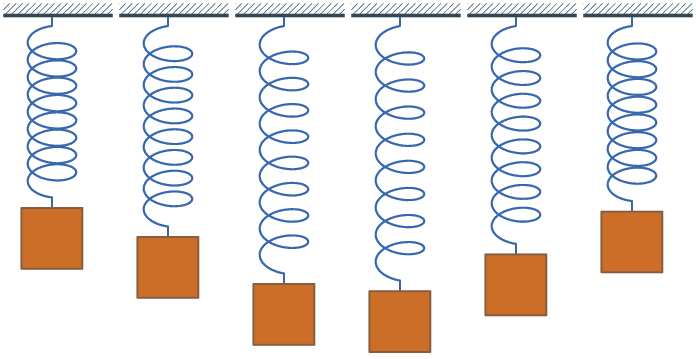
Oscillation is a periodic to and fro motion of an object about its mean position. Oscillation is also called as vibration. Another example is shown below.
Spring mass oscillatory
system
The simplest mechanical oscillating system is a mass attached to a linear spring subject to no other forces. Such a system may be approximated on an air table or ice surface. The system is in an equilibrium state when the spring is static. If the system is displaced from the equilibrium, there is a net restoring force on the mass, tending to bring it back to equilibrium. However, in moving the mass back to the equilibrium position, it has acquired momentum which keeps it moving beyond that position, establishing a new restoring force in the opposite sense. If a constant force such as gravity is added to the system, the point of equilibrium is shifted. The time taken for an oscillation to occur is often referred to as the oscillatory period or the time period.

Wednesday, January 25, 2012

Uses of gravity

Gravitational force is needed a lot. We depend on gravity for many things.

  1. We are able to stand on the Earth's surface only because of gravity. The Gravitational force keeps us bound to the Earth's surface and does not let us escape to vacuum though rockets have enough power to do so. Gravity varies from place to place.
  2. The fluids in our body are right in their places because gravity holds them.
  3. The muscles in our body can be made stronger only because of gravity.
  4. The Sun, Moon, Earth and celestial objects are in the orbits only because of gravity.
  5. The satellites which are supposed to reach far away planets like Uranus, Jupiter etc use the centripetal force exerted by the gravity to gain momentum and travel farther distances.
  6. The light from a distant planet is bent by the gravity of a celestial object which helps us to calculate the distance of the Star.
  7. A stellar system with a planet can be found out using Doppler effect which works on Gravity.

Tuesday, January 24, 2012

Gravitational Energy

Gravitation, or gravity, is a natural phenomenon by which physical bodies attract with a force proportional to their mass. Gravitation is most familiar as the agent that gives weight to objects with mass and causes them to fall to the ground when dropped. Gravitation causes dispersed matter to coalesce, and coalesced matter to remain intact, thus accounting for the existence of the Earth, the Sun, and most of the macroscopic objects in the universe.


The motion of celestial bodies such as the moon, the Earth, the Planets, etc., has been a subject of great interest for a long time. Famous Indian Mathematician and Astronomer, Aryabhatta, studied these motions in great detail(5th century A.D). He established that the Earth revolves its own axis around the Sun and the Moon also revolves around the Earth. 

A thousand years later, Tycho Brahe and Johannes Kepler. Kepler formulated his important findings and put it as three laws of planetary motion.

  1. All planets move in elliptical orbits around the sun at a focus.
  2. The radius vector from the sun to the planet sweeps equal areas in equal time.
  3. The square of the time period of a planet is proportional to the cube of the semi-major axis of the ellipse.
Newton tried to use these laws and formulated the law of gravitation. The formula is 
Gravitation is one of the four fundamental interactions of nature, along with electromagnetism, and the nuclear strong force and weak force. Modern physics describes gravitation using the general theory of relativity by Einstein, in which it is a consequence of the curvature of space-time governing the motion of inertial objects. The simpler Newton's law of universal gravitation provides an accurate approximation for most physical situations.

Equivalence PrincipleThe equivalence principle, explored by a succession of researchers including Galileo, Loránd Eötvös, and Einstein, expresses the idea that all objects fall in the same way. The simplest way to test the weak equivalence principle is to drop two objects of different masses or compositions in a vacuum, and see if they hit the ground at the same time. These experiments demonstrate that all objects fall at the same rate when friction (including air resistance) is negligible. More sophisticated tests use a torsion balance of a type invented by Eötvös. Satellite experiments, for example STEP, are planned for more accurate experiments in space.
Formulations of the equivalence principle include:
  • The weak equivalence principle: The trajectory of a point mass in a gravitational field depends only on its initial position and velocity, and is independent of its composition.
  • The Einsteinian equivalence principle: The outcome of any local non-gravitational experiment in a freely falling laboratory is independent of the velocity of the laboratory and its location in space-time.
  • The strong equivalence principle requiring both of the above.
The equivalence principle can be used to make physical deductions about the gravitational constant, the geometrical nature of gravity, the possibility of a fifth force, and the validity of concepts such as general relativity and Brans-Dicke theory.
Gravity and Quantum MechanicsIn the decades after the discovery of general relativity it was realized that general relativity is incompatible with quantum mechanics. It is possible to describe gravity in the framework of quantum field theory like the other fundamental forces, such that the attractive force of gravity arises due to exchange of virtual gravitons, in the same way as the electromagnetic force arises from exchange of virtual photons. This reproduces general relativity in the classical limit. However, this approach fails at short distances of the order of the Planck length, where a more complete theory of quantum gravity (or a new approach to quantum mechanics) is required. Many believe the complete theory to be string theory, or more currently M-theory, and, on the other hand, it may be a background independent theory such as loop quantum gravity or causal dynamical triangulation.
Gravity in accordance with astronomyThe discovery and application of Newton's law of gravity accounts for the detailed information we have about the planets in our solar system, the mass of the Sun, the distance to stars, quasars and even the theory of dark matter. Although we have not traveled to all the planets nor to the Sun, we know their masses. These masses are obtained by applying the laws of gravity to the measured characteristics of the orbit. In space an object maintains its orbit because of the force of gravity acting upon it. Planets orbit stars, stars orbit Galactic Centers, galaxies orbit a center of mass in clusters, and clusters orbit in super-clusters. The force of gravity exerted on one object by another is directly proportional to the product of those objects' masses and inversely proportional to the square of the distance between them.
Gravitational RadiationIn general relativity, gravitational radiation is generated in situations where the curvature of spacetime is oscillating, such as is the case with co-orbiting objects. The gravitational radiation emitted by the Solar System is far too small to measure. However, gravitational radiation has been indirectly observed as an energy loss over time in binary pulsar systems such as PSR B1913+16. It is believed that neutron star mergers and black hole formation may create detectable amounts of gravitational radiation. Gravitational radiation observatories such as LIGO have been created to study the problem. No confirmed detections have been made of this hypothetical radiation, but as the science behind LIGO is refined and as the instruments themselves are endowed with greater sensitivity over the next decade, this may change.
A comet in motion gradually will come to rest after billions of years though there is no friction in vacuum because it loses energy in the form of gravitational waves.

Monday, January 23, 2012

Friction

Friction is a resisting force which opposes the movement or relative motion of two surfaces in contact with each other. Friction does not let two bodies slide easily.
There are several types of friction

  1. Dry Friction: Friction that exists between two solid surfaces in contact.
  2. Fluid friction or viscosity: Friction that exists between layers of a viscous fluid.
  3. Skin friction: A force which opposes the movement of a solid through a fluid.
  4. Internal Friction: Friction that exists in a solid which opposes its deformation.
The Force of Friction exists when a body is stationary as well as moving. The friction that exist when a body is stationary is called static friction
Static Friction makes a body stay in its position even though a small amount of external force is being applied(depends on the roughness of the surface). It is denoted by μs.

The static friction force must be overcome by an applied force before an object can move. The maximum possible friction force between two surfaces before sliding begins is the product of the coefficient of static friction and the normal force: f = \mu_s F_{n}\,. When there is no sliding occurring, the friction force can have any value from zero up to F_{max}\,. Any force smaller than F_{max}\, attempting to slide one surface over the other is opposed by a frictional force of equal magnitude and opposite direction. Any force larger than F_{max}\, overcomes the force of static friction and causes sliding to occur. The instant sliding occurs, static friction is no longer applicable—the friction between the two surfaces is then called kinetic friction.

Friction between a body and a surface when the body is moving is called Kinetic friction. It is denoted by μk.
The Kinetic Friction is smaller than Static Friction.

Angle of Friction: For certain applications it is more useful to define static friction in terms of the maximum angle before which one of the items will begin sliding. This is called the angle of friction or friction angle. It is defined as:
\tan{\theta} = \mu\,
where θ is the angle from vertical and µ is the static coefficient of friction between the objects. This formula can also be used to calculate µ from empirical measurements of the friction angle.
Static Friction as limiting friction:
Static Friction behaves rather differently in different situations. Experiments show that static friction increases with the increase in external forces being applied. The friction keeps increasing until it meets a certain value or reaches its limit. Then the friction is no longer static. Its kinetic as told above. Thus we can conclude that its is harder to begin the motion of an object rather than keeping it in motion.

Calculating Force of Friction

Friction between each surfaces can be calculated using an equation or idea given by Charles-Augustin de Coulomb. The equation is .
where
  • F_\mathrm{f}\, is the force of friction exerted by each surface on the other. It is parallel to the surface, in a direction opposite to the net applied force.
  • \mu\, is the coefficient of friction, which is an empirical property of the contacting materials,
  • F_\mathrm{n}\, is the normal force exerted by each surface on the other, directed perpendicular (normal) to the surface.

Concept of Normal Force: The normal force is defined as the net force compressing two parallel surfaces together; and its direction is perpendicular to the surfaces. From Newton's third law of motion, we can say that Normal force is a reaction to the force an object is applying on the surface.

In the simple case of a mass resting on a horizontal surface, the only component of the normal force is the force due to gravity, where N=mg\,. In this case, the magnitude of the friction force is the product of the mass of the object, the acceleration due to gravity, and the coefficient of friction. However, the coefficient of friction is not a function of mass or volume; it depends only on the material. For instance, a large aluminum block has the same coefficient of friction as a small aluminum block. However, the magnitude of the friction force itself depends on the normal force, and hence the mass of the block.
If an object is on a level surface and the force tending to cause it to slide is horizontal, the normal force N\, between the object and the surface is just its weight, which is equal to its mass multiplied by the acceleration due to earth's gravity, g. If the object is on a tilted surface such as an inclined plane, the normal force is less, because less of the force of gravity is perpendicular to the face of the plane. Therefore, the normal force, and ultimately the frictional force, is determined using vector analysis, usually via a free body diagram. Depending on the situation, the calculation of the normal force may include forces other than gravity.

Laws of Friction:
The elementary properties of sliding (kinetic) friction were discovered by experiment in the 15th to 18th centuries and were expressed as three empirical laws:
  • Amontons' First Law: The force of friction is directly proportional to the applied load.
  • Amontons' Second Law: The force of friction is independent of the apparent area of contact.
  • Coulomb's Law of Friction: Kinetic friction is independent of the sliding velocity.
Amontons' 2nd Law is an idealization assuming perfectly rigid and inelastic materials. For example, wider tires on cars provide more traction than narrow tires for a given vehicle mass because of surface deformation of the tire.

Fluid Friction: Fluid friction occurs between layers within a fluid that are moving relative to each other. This internal resistance to flow is described by viscosity. In everyday terms viscosity is "thickness". Thus, water is "thin", having a lower viscosity, while honey is "thick", having a higher viscosity. Put simply, the less viscous the fluid is, the greater its ease of movement.

All real fluids (except superfluids) have some resistance to stress and therefore are viscous, but a fluid which has no resistance to shear stress is known as an ideal fluid or inviscid fluid.

Sunday, January 22, 2012

Special article: How synthetic elements are made

Synthetic elements are those which do not occur naturally in on Earth. They are made by a procedure called as Nuclear Fusion and is called as bombardment in this process. Its is called as bombarding because some elements are made by colliding a different elements but most of them are made by fusion of an α particle with the nucleus of the previous element.


α + Lithium = Boron


Bombarding: The process of bombarding is very simple. The atom to bombarded is kept in front of an α emitter  which emits α particles. The high energy and velocity particle fuse with the nucleus of the element and increase its atomic number by 2 and mass number by 4. To obtain an element with even number of protons/neutrons and element with even number of protons/neutrons is taken. Example: curium, with 96 protons in its nucleus, can be bombarded by high-energy helium ions, each containing two protons along with two neutrons, to yield californium with 98 protons in its nucleus.
Similarly odd numbered element for odd number of protons/neutrons.

Thursday, January 12, 2012

Potential Energy

In physicspotential energy is the energy of a body or a system with respect to the position of the body or the arrangement of the particles of the system. The SI unit of measure for energy and work is the Joule (symbol J). The term "potential energy" was coined by the 19th century Scottish engineer and physicist William Rankine.


Gravitational energy is the potential energy associated with gravitational force. If an object falls from one point to another point inside a gravitational field, the force of gravity will do positive work on the object, and the gravitational potential energy will decrease by the same amount.


Consider a book placed on top of a table. As the book is raised from the floor, to the table, some external force works against the gravitational force. If the book falls back to the floor, the "falling" energy the book receives is provided by the gravitational force. Thus, if the book falls off the table, this potential energy goes to accelerate the mass of the book and is converted into kinetic energy. When the book hits the floor this kinetic energy is converted into heat and sound by the impact.
The factors that affect an object's gravitational potential energy are its height relative to some reference point, its mass, and the strength of the gravitational field it is in. Thus, a book lying on a table has less gravitational potential energy than the same book on top of a taller cupboard, and less gravitational potential energy than a heavier book lying on the same table. An object at a certain height above the Moon's surface has less gravitational potential energy than at the same height above the Earth's surface because the Moon's gravity is weaker. Note that "height" in the common sense of the term cannot be used for gravitational potential energy calculations when gravity is not assumed to be a constant.